









If your lead developer leaves tomorrow, your business could face serious challenges. Here’s why this matters and what you can do to prepare:
- Critical knowledge gaps: Lead developers often hold undocumented insights about your systems. Their departure can turn systems into "black boxes" no one else fully understands.
- Project delays and risks: Active projects may stall, deadlines can slip, and deployments become risky without their expertise.
- Team stress and morale issues: Remaining developers may feel overwhelmed, leading to burnout and lower productivity.
- Costly disruptions: Hiring consultants or replacements can be expensive and time-consuming, with fees easily reaching six figures.
- Long-term risks: Prolonged vacancies slow product development, damage company culture, and erode competitiveness.
What can you do?
- Build a culture of knowledge sharing to avoid silos.
- Train multiple team members on critical systems.
- Use tools like documentation platforms and access management to keep work visible and secure.
Taking action now reduces the risks of unexpected departures. If you’re unprepared, services like Equifier can help with staffing, knowledge transfer, and securing your systems.
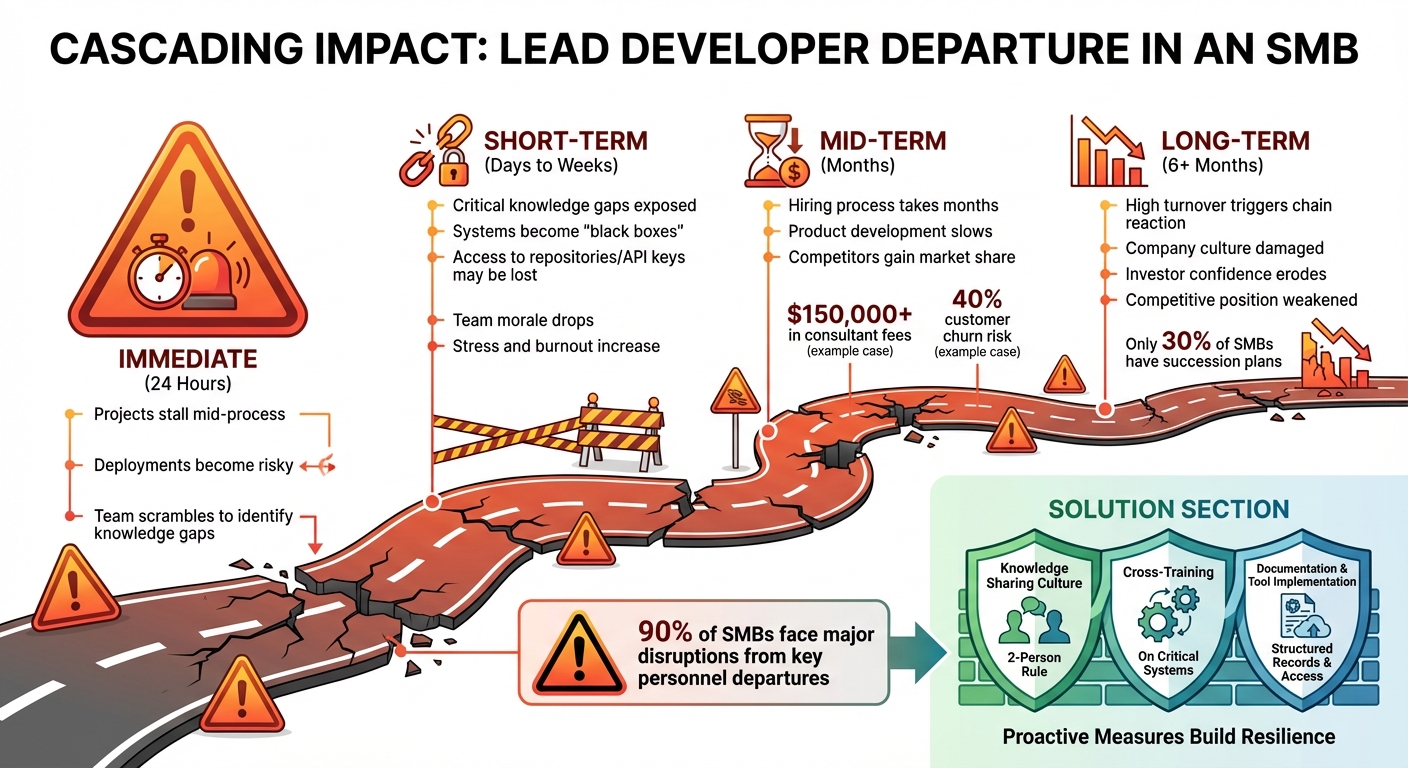
Timeline of Business Impact After Lead Developer Departure
What Happens Right After Your Lead Developer Leaves
The first 24 hours after your lead developer leaves can feel like a whirlwind. Projects that were steadily progressing suddenly grind to a halt, and your team scrambles to figure out who knows what. Often, the answer is unsettling: no one. Here’s a closer look at how this impacts your projects and your team.
Projects Stall and Deadlines Slip Away
When a lead developer exits, active development often stops in its tracks. Bug fixes and new features get stranded mid-process, especially if they were the ones overseeing those areas. Suddenly, deploying code becomes a risky endeavor because the operational know-how to navigate the pipeline is missing.
Take the example of a startup in August 2025. Their lead engineer, who had single-handedly built their user authentication system, left unexpectedly. Within days, user login issues surfaced, followed by a major security vulnerability. Customer complaints poured in, and the company had no choice but to hire costly consultants to reverse-engineer the system. The fallout? $150,000 in consultant fees and a 40% customer churn rate.
Without the lead developer’s expertise, deployments that were once routine turn into high-stakes gambles. The lack of knowledge surrounding troubleshooting methods or known workarounds only amplifies the chaos.
Critical Knowledge Walks Out the Door
Your lead developer wasn’t just writing code – they were the keeper of years of undocumented insights. They understood the “why” behind every system design choice and knew which APIs were unreliable or prone to failure.
When they leave, those systems can turn into untouchable "black boxes." The team may hesitate to make changes, fearing they’ll break something they don’t fully understand. To make matters worse, access to critical resources – like code repositories, API keys, or vendor account passwords – might disappear along with them. What looked like a well-documented setup quickly reveals glaring gaps that only one person could fill.
Team Morale Takes a Nosedive
The technical void left behind doesn’t just disrupt operations – it also shakes your team’s confidence. The remaining developers are left grappling with systems they barely understand, often under intense pressure to keep things running smoothly. This added stress can lead to resentment, burnout, and even imposter syndrome as they struggle to manage unfamiliar, complex code.
On top of that, the sudden departure can leave the team feeling blindsided and uncertain about the future. Questions like “Who’s next to leave?” or “Can we handle this workload?” creep in, further eroding morale. As confidence dwindles, productivity often follows suit, leaving the team in a vulnerable state.
The Long-Term Risks You Can’t Ignore
When a lead developer leaves, the fallout can extend far beyond immediate delays and team morale issues. Over time, what starts as a staffing gap can snowball into a strategic breakdown, putting the foundation of your business at risk. These long-term challenges highlight why taking proactive steps is so important.
Finding a Replacement Is Harder Than You Think
Replacing a lead developer isn’t a quick or simple process – it can take months. Between scheduling interviews, evaluating candidates, and negotiating offers, valuable time slips away, leaving projects in limbo. And with the typical two-to-four-week notice period, there’s rarely enough time to ensure a smooth knowledge transfer before the outgoing developer departs.
Even after hiring someone new, there’s no guarantee they’ll stay. If they leave shortly after onboarding, the cycle of delays and rising recruitment costs starts all over again. Meanwhile, your development pipeline suffers from the prolonged vacancy.
Your Product Development Slows Down
Without a skilled technical leader at the helm, your team’s focus shifts from innovation to firefighting. Instead of rolling out new features, developers are forced to navigate complex, undocumented systems that were once expertly managed by the departed lead.
Those "dark modules" in your codebase – areas only your lead developer fully understood – become untouchable. Team members hesitate to make changes, fearing they might break critical functionality. Every deployment feels like a gamble, increasing the risk of errors and downtime.
While you wrestle with these internal challenges, competitors continue to release updates and capture market share. Delayed product launches erode investor confidence, and your ability to stay competitive weakens.
High Turnover Damages Your Company Culture
When one key player leaves, it often triggers a chain reaction. Remaining engineers find themselves overwhelmed, taking on unfamiliar tasks and working longer hours just to keep things running. This added stress can lead to burnout, frustration, and a growing sense of inadequacy as they struggle with systems they don’t fully understand.
The result? More resignations. This creates a ripple effect, signaling instability not just to your team but also to clients and potential hires. With only 30% of small businesses having a formal succession plan, many are left vulnerable, exposing just how fragile their technical operations really are.
These risks underline the importance of having a clear succession strategy and building operational resilience to weather unexpected departures.
How to Protect Your Business From This Scenario
Avoid the chaos of losing a lead developer by putting safeguards in place now. By weaving resilience into your team’s daily operations, you can keep disruptions to a minimum. Here are some strategies to help you prepare.
Create a Culture of Knowledge Sharing
Knowledge sharing shouldn’t be an afterthought – it needs to be part of your team’s routine. Instead of relying on lengthy handoff sessions, integrate learning into everyday tasks. As Min Ong, CTO at nate, puts it: "Generally, we found that learning by doing has been better than just over-explaining the whole system". One way to do this is by having developers tackle small, unfamiliar sections of code during each sprint. This hands-on approach builds understanding and keeps critical knowledge from being siloed.
There are also great examples of companies taking knowledge sharing to the next level. In 2013, ConocoPhillips launched a "Network of Excellence" (NoE) to promote peer-to-peer problem solving. Within a year, they established company-wide standards for plant maintenance and trained over 1,000 employees using digital training modules. Similarly, you could introduce video walkthroughs for complex processes. Encourage your team to record short screen-share guides for tasks like deployments, troubleshooting, or navigating workflows. These videos capture the kind of expertise that’s hard to put into words. For instance, Xerox’s "XstreamVideo" program, started in 2016, let employees create unscripted training videos. By 2019, over 70% of their instructional content was employee-generated, surpassing their goals.
By embedding knowledge sharing into daily work, you’ll build a solid foundation for long-term resilience.
Train Multiple People on Critical Systems
To avoid a single point of failure, apply the 2-Person Rule: make sure at least two people are familiar with every critical system. This way, someone is always ready to step in if needed.
Start with an Application Portfolio Assessment. Create a list of all production applications, rank them by importance, and identify any "orphaned" systems that don’t have an owner. This process helps you spot vulnerabilities early. Namrata Shah, Senior Director of Software Engineering at Avanade, emphasizes the importance of documentation: "As long as it’s a living system in your production, there should be enough documentation – because you never know when someone will wake up from their sleep and ask you a really good question".
Rotation systems can also help. By having developers work on different parts of a project during each sprint, you ensure that knowledge isn’t concentrated in one person’s head. Pair programming is another effective way to speed up this learning process, giving junior developers real-time guidance from senior team members.
Make documentation a non-negotiable part of your workflow. Update your team’s "Definition of Done" to include documentation as a requirement for task completion. Use tools like Architecture Decision Records to explain the reasoning behind major technical choices. CNA’s "knowledge advocate" program, introduced in 2013, even tied knowledge-sharing goals to annual performance reviews, reinforcing the idea that thorough documentation is essential.
These steps ensure that your team is prepared to handle transitions smoothly.
Use the Right Tools to Keep Work Visible
The right tools can make all the difference when it comes to managing transitions. Use a Git repository with clear commit messages and ownership details to store your code. Project management tools like Jira or Trello can keep tasks visible and responsibilities clear during handoffs. Tools like git blame can also help identify "Dark Modules" where a single developer owns more than 50% of the logic. These areas might need immediate attention, such as pair programming or dedicated documentation sprints.
Centralized knowledge bases like Confluence or Stack Overflow for Teams are another must-have. They can store guides, troubleshooting steps, and system overviews that remain accessible long after someone leaves. Jeff Lai from Canva’s Internal Infrastructure team highlights the value of this approach: "Work becomes a lot more visible when it’s all in one place. It makes collaboration a whole lot easier and facilitates that transparency".
Don’t forget about access management. Ensure multiple team members – not just one – have credentials for critical systems, hosting platforms, and cloud services. Relying on a single person for admin access is a risk you can easily avoid. Lastly, a robust test suite can double as technical documentation, providing insights into a developer’s original intent and alerting the team if changes disrupt functionality.
sbb-itb-05efa2a
How Equifier Helps SMBs Prepare for Team Changes
While internal efforts like knowledge sharing and cross-training are important, Equifier provides expert external support to help maintain operational stability during team transitions.
When a key team member, like your lead developer, leaves, quick solutions are essential. Equifier’s services are specifically designed to help small and mid-sized businesses (SMBs) navigate these changes without compromising on operations or security. Here’s how their solutions ensure a swift recovery and protect your business.
Fast Access to Qualified IT Professionals
When it comes to replacing a key team member, speed matters. Equifier leverages a national network of candidates and a team of specialized recruiters to quickly fill both full-time and contract roles. This streamlined process significantly reduces the time needed to find the right fit, which is especially critical given that only 30% of small businesses have a written succession plan.
Equifier’s strategy includes tapping into external talent pools, identifying high-potential candidates through professional platforms, industry events, and publications. Additionally, they rely on seasoned professionals who have experience handling growth challenges and can immediately adapt to your business environment. This rapid staffing approach sets the stage for a smooth transition.
IT Consulting to Smooth Out Transitions
Equifier’s IT consulting services kick off with an immediate crisis assessment when a key team member departs. This assessment identifies critical knowledge gaps, evaluates team capacity, and pinpoints systems at risk of failure if left unmanaged. Consultants also analyze your codebase to locate "Dark Modules" (areas where one developer controls more than 50% of the code), addressing the Bus Factor risk.
In the first week, Equifier focuses on knowledge extraction sprints, documenting essential details like high-level system architecture, deployment processes, troubleshooting protocols, and external API dependencies. They also implement structured cross-training through pair programming and daily knowledge-sharing sessions to ensure at least two team members are familiar with every critical system. This approach helps prevent costly disruptions, such as the "authentication catastrophes" that can lead to $150,000 in consultant fees and 40% customer churn due to service instability.
Securing Critical Systems During Transitions
Personnel changes often increase security vulnerabilities, but Equifier’s cybersecurity services help SMBs stay protected. They use automated access management tools like Microsoft Azure Active Directory or Okta to quickly update user permissions, ensuring departing employees lose access immediately. Offboarding also includes final security audits to confirm all access is revoked and to check for potential data breaches.
Equifier takes over root access and ownership of critical assets – such as code repositories, cloud accounts (AWS, Azure), domain registrars, and third-party services – right away. They also implement multi-layered encryption for data at rest (using tools like BitLocker or FileVault) and data in transit (via TLS or VPNs). These measures are vital, especially when unaddressed technical debt in large-scale applications can cost businesses an estimated $306,000 annually.
Conclusion
Get ready now to protect your business from the fallout of losing a lead developer. Statistics show that only about one-third of SMBs have a proper succession plan, yet over 90% have dealt with major disruptions caused by key personnel departures. It’s not a matter of if this will happen – it’s a matter of when.
As we’ve covered, strategies like cross-training, documentation sprints, and fostering a knowledge-sharing culture are critical. Start by assessing your Bus Factor, then focus on strengthening your team’s ability to share knowledge, train across roles, and maintain up-to-date documentation. As Antonio Angelino, Tech Lead Coach, wisely states:
"The time to build resilience is before you need it, not during the crisis of a key departure".
Building this internal resilience ensures your team is better prepared to handle unexpected challenges. And when those challenges arise, external support can make all the difference. Equifier offers services like rapid staffing, crisis assessment consulting, and security protocols to help SMBs navigate sudden personnel changes. Whether it’s finding qualified IT professionals in just days or securing critical systems during transitions, these solutions address gaps that internal planning alone might not fully cover.
The risks of doing nothing are far too great. Don’t wait until it’s too late – whether through internal planning or expert assistance, take action now to ensure your business is ready for the inevitable changes ahead.
FAQs
How can I avoid losing critical knowledge if my lead developer leaves?
To avoid losing crucial knowledge when your lead developer decides to leave, start by prioritizing strong documentation practices. Make sure all work, code, and key decisions are thoroughly documented and stored in accessible formats like internal wikis or knowledge bases. This ensures that other team members can easily pick up where the lead developer left off, keeping projects on track.
Another smart move is to promote cross-training and task rotation within your team. By having team members regularly share responsibilities and learn from one another, you reduce the risk of relying too heavily on a single individual. Pair this with regular updates to documentation and fostering open communication to ensure that everyone stays informed and aligned.
Lastly, think ahead with succession planning. Develop knowledge transfer plans proactively, so you’re ready to maintain smooth operations and minimize disruptions during any transitions.
What should I do if my lead developer suddenly leaves?
If your lead developer suddenly leaves, the first step is to secure all key assets. This includes code repositories, project documentation, databases, and communication records. Having these in place ensures you retain vital information and can keep things running smoothly, at least in the short term.
Once that’s done, take a close look at the current state of your projects. Pinpoint any major roadblocks, test the functionality of completed work, and document any gaps, like missing features or unresolved issues. If possible, try reaching out to the departing developer to retrieve any unfinished tasks or essential assets.
Lastly, think about strengthening your team to avoid similar situations down the road. Start by updating documentation, cross-training team members, and encouraging knowledge-sharing. These steps can help your team stay prepared and reduce disruptions in the future. A little planning now can go a long way in ensuring stability.
How can Equifier help SMBs stay prepared if a lead developer leaves unexpectedly?
Equifier helps small and medium businesses (SMBs) navigate unexpected personnel changes by focusing on knowledge sharing and team readiness. With tools designed to encourage detailed documentation and smooth knowledge transfer, critical information is captured and made available to the entire team. This approach prevents any single person from becoming a bottleneck in ongoing projects.
Beyond documentation, Equifier emphasizes cross-training employees and creating succession plans to reduce reliance on specific individuals. By incorporating project management tools and code repositories, the platform simplifies onboarding for new team members, ensuring minimal disruption. These strategies keep your business steady and your projects moving forward, even when the unexpected happens.