










Manual software releases are outdated, error-prone, and inefficient. They rely on engineers manually deploying code, often using undocumented processes, which leads to:
- Frequent errors: 56% of companies face release issues monthly, with only 6% detecting them in real time.
- Slower timelines: Manual steps delay releases, forcing teams to bundle changes, increasing risks.
- Security risks: Patches are often delayed, leaving systems exposed to vulnerabilities.
- High costs: U.S. companies lose trillions annually to operational failures and security breaches caused by manual processes.
Switching to automated CI/CD pipelines solves these problems by enabling faster, consistent, and secure deployments. Tools like Jenkins, GitLab, and Kubernetes streamline workflows, reduce human error, and integrate security checks early. Automation also cuts downtime, improves developer productivity, and ensures compliance with regulations.
Key takeaway: Manual releases are expensive and risky. Automation is the clear solution for efficient, reliable, and secure software deployment.
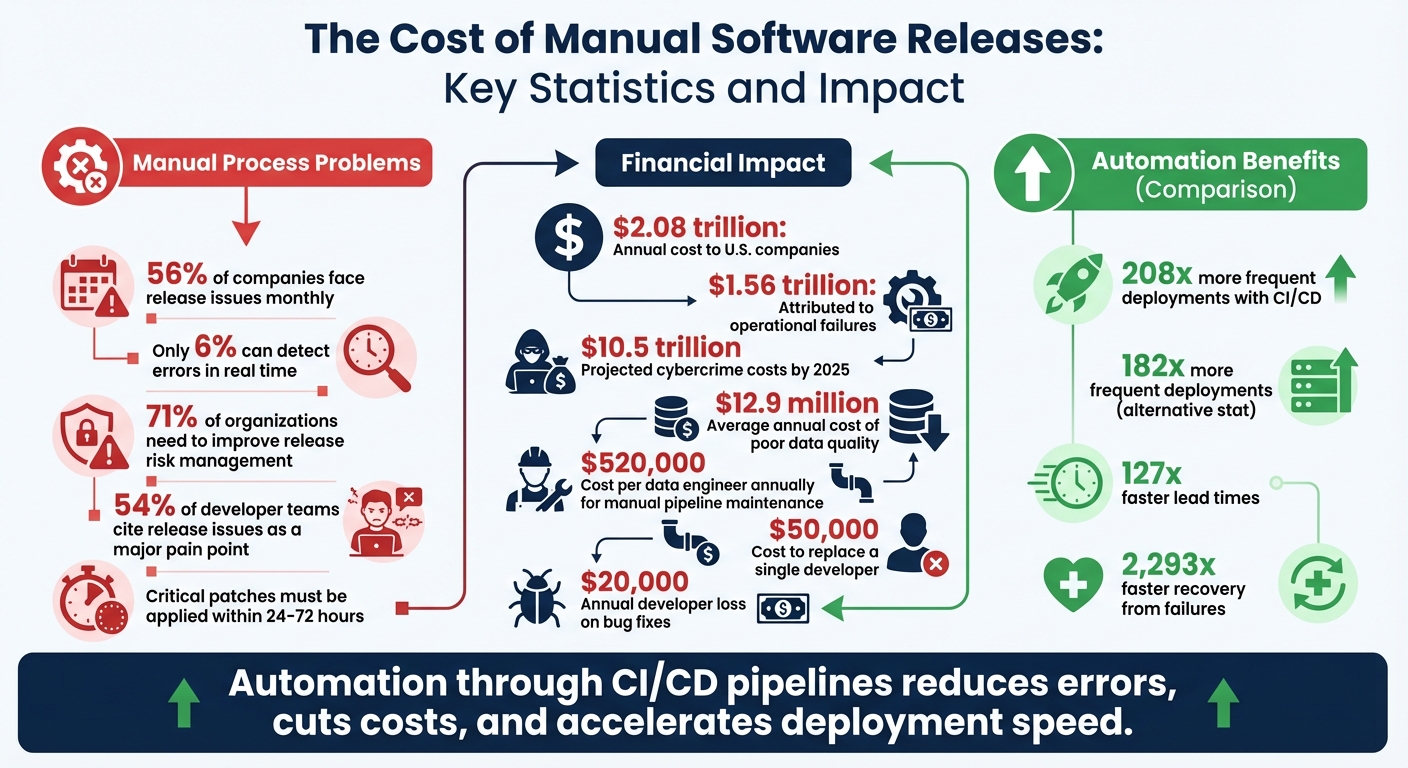
The Cost of Manual Software Releases: Key Statistics and Impact
CI/CD Explained: The DevOps Skill That Makes You 10x More Valuable
Problems with Manual Software Releases
Manual software releases come with a host of challenges that can severely impact operational efficiency. These issues highlight why relying on manual processes is increasingly impractical in today’s fast-paced development environments.
Slower Release Cycles and Development Schedules
Manual release processes drag out production timelines, making it harder for developers to debug and fix issues efficiently. With every handoff requiring meetings and coordination, valuable time is wasted – time that doesn’t show up on project burndown charts but slows progress nonetheless. To avoid frequent deployment headaches, teams tend to bundle changes into larger releases. Ironically, this approach makes each release riskier and harder to troubleshoot. As one expert explains:
"When releases are painful, teams naturally batch changes together to minimize the pain. This paradoxically makes each release riskier and harder to debug".
Automation offers a stark contrast, enabling deployments 182 times more frequently and reducing lead times by 127 times. Companies like LinkedIn have experienced this firsthand. After struggling with a cumbersome manual process, they transitioned to automated systems, moving from biweekly to daily releases while cutting down outages.
Higher Error Rates and Missed Security Issues
Manual processes introduce inconsistencies, as deployment steps can vary depending on the individual executing them. Common mistakes include deploying binaries with debugging features still enabled or misconfiguring production environments to point to testing backends.
The numbers paint a grim picture: 56% of organizations encounter software release errors at least once a month, yet only 6% can detect these issues in real time. This means most problems aren’t caught until users report them – or worse, until a security breach occurs. Manual workflows are especially prone to overlooking subtle issues, such as errors triggered by specific user inputs (e.g., names with apostrophes) or database mismatches that only surface under certain conditions.
Experts Jeremiah Spradlin and Mark Lodato from Google stress the importance of treating configuration with the same rigor as code:
"A service’s configuration is just as critical to security and reliability as the service’s code. Therefore, all the best practices regarding code versioning and change review apply to configuration as well".
Without automated checks, engineers might unknowingly deploy unreviewed code or bypass security steps during emergencies, leaving systems exposed to vulnerabilities. This lack of consistency amplifies risks, making automated quality gates a necessity.
Security Gaps and Compliance Problems
Manual patching creates dangerous delays in addressing vulnerabilities. With thousands of new CVEs (Common Vulnerabilities and Exposures) published annually, critical patches need to be applied within 24–72 hours to minimize risks. Unfortunately, manual teams often miss these tight windows, leaving systems exposed to known threats actively exploited by attackers.
Compliance requirements add another layer of complexity. Regulations like HIPAA, PCI DSS, and GDPR mandate timely updates and proper documentation. Manual processes often fail to provide the audit trails and consistency needed to prove compliance. When 71% of organizations acknowledge the need to improve release risk management, it’s clear that manual methods fall short.
Recovery from failures is yet another weak point. Rolling back a manual deployment is error-prone, especially when database schema changes are involved, as older versions may not support the updated schema. By contrast, companies with automated systems recover from deployment failures 2,293 times faster than those using manual processes. This speed can mean the difference between a minor hiccup and a major incident.
The vulnerabilities inherent in manual releases underscore the critical need for automation to streamline processes, reduce risks, and improve overall efficiency.
Business Costs of Manual Software Releases
Financial Impact of Errors and Security Breaches
The risks of manual processes go beyond operational inefficiencies – they come with staggering financial consequences.
Manual software releases cost U.S. companies an estimated $2.08 trillion annually, with $1.56 trillion attributed to operational failures. Nearly half of every dollar spent during the software lifecycle is used to fix bugs, and developers themselves lose approximately $20,000 per year on bug fixes alone. Replacing a single developer? That can set a company back around $50,000.
Security breaches add another layer of financial strain. High-profile incidents like the December 2020 SolarWinds attack, the October 2021 Facebook outage, and the May 2017 British Airways disruption have resulted in losses ranging from millions to hundreds of millions of dollars. And with cybercrime on the rise, the projected annual costs could climb to $10.5 trillion by 2025. Laura Marwick from Raygun highlights the importance of addressing errors:
"If you don’t measure, track, or resolve errors, you’re ignoring a loss in revenue".
Wasted Resources and Scalability Challenges
Manual processes don’t just cost money – they waste time and limit growth. Around 54% of developer teams cite release issues as a significant pain point, yet only 6% can detect problems in real time. This leaves teams scrambling to fix issues reactively, pulling resources away from forward-thinking projects.
Another challenge? Manual releases often depend on undocumented knowledge held by a few key individuals, the so-called "heroes." When these team members are unavailable, deployments come to a halt, increasing delays and coordination headaches. What works for a small team becomes chaotic and unmanageable as the team grows.
Data engineers face a similar struggle, spending 40%–60% of their time on maintenance and troubleshooting instead of innovation. In some cases, maintaining manual pipelines costs organizations about $520,000 per engineer annually. External data integration costs are often underestimated by 35% to 70%, and poor data quality – often the result of manual errors – costs businesses an average of $12.9 million each year.
As systems grow more complex with the rise of microservices and faster release cycles, the manual effort required for deployments increases exponentially. This constant need for maintenance becomes a major drain on resources.
The numbers are clear: automating software releases is no longer optional. It’s the first step toward cutting these financial and resource losses while enabling teams to focus on innovation and scalability.
sbb-itb-05efa2a
Automating Software Releases with CI/CD Pipelines
Main Benefits of Automation
CI/CD pipelines take the headaches out of manual software releases by cutting down on human errors. Teams that fully embrace CI/CD can deploy updates 208 times more frequently than those sticking to older methods. This boost in speed means deployments are not only faster but also more consistent and reliable.
Gone are the days of dreaded "merge days", where manual deployments often lead to chaos. With an automated pipeline, updates can flow continuously throughout the day. The process becomes predictable and repeatable across development, staging, and production environments. Plus, automated testing kicks in immediately, catching issues early when they’re easier – and cheaper – to fix.
Juni Mukherjee, Developer Advocate, highlights the advantages:
"Pipelines are exponentially better than manual error-prone release processes, since, unlike humans, pipelines don’t falter under aggressive deadlines".
Security is baked into the workflow, too. DevSecOps practices integrate automated security scans – like SAST, DAST, and dependency checks – right into the pipeline. This "shift-left" approach ensures security is a priority from the start, helping teams prevent vulnerabilities before they ever reach production.
Automation also boosts developer productivity. Freed from repetitive, manual tasks, teams can focus on building and innovating. Andrew Mulholland, Director of Engineering, sums it up well:
"The mindset we carry is that we always want to automate ourselves into a better job. We want to make sure that the task we’re doing manually today becomes mostly automated".
Automated pipelines also manage risk effectively. By deploying small, incremental changes, teams can quickly roll back updates if something goes wrong. To unlock these benefits, though, selecting the right tools is key.
Tools for Automated Releases
Several CI/CD platforms lead the way in automating workflows. Jenkins, with its massive plugin ecosystem, offers unparalleled flexibility. GitLab, on the other hand, combines CI/CD with an integrated DevSecOps platform, boasting nearly 30 million users as of early 2025. Both tools integrate seamlessly with container technologies and Infrastructure-as-Code solutions.
For consistent application performance across environments, Docker and Kubernetes are indispensable. Meanwhile, tools like Terraform and Ansible automate infrastructure provisioning, turning manual server setups into reusable code. Other strong CI/CD options include GitHub Actions, CircleCI, and Bitbucket Pipelines, each offering robust features tailored to different version control systems.
Starting small is often the best strategy. Pick a pilot project with straightforward testing needs and focus on automating the most error-prone tasks first. Make sure to version everything – application code, configurations, scripts, and even documentation. Modern pipelines are also beginning to leverage AI for troubleshooting, automatically diagnosing build failures and suggesting fixes to minimize downtime.
Equifier‘s Solutions for Secure and Efficient Software Releases

IT Infrastructure Optimization with Equifier
Equifier takes the guesswork out of software releases by replacing manual processes with Infrastructure as Code (IaC). Using tools like Terraform or CloudFormation, manual setups are transformed into version-controlled, reusable scripts, making deployments more predictable and efficient. By leveraging cloud-native architectures such as Docker and Kubernetes, Equifier ensures that releases are not only scalable but also automated.
Security isn’t an afterthought here – it’s integrated from the start. Equifier adopts a "shift-left" approach, embedding security measures like Software Composition Analysis (SCA), secret scanning, and image scanning throughout the development pipeline. This strategy addresses critical vulnerabilities such as poor identity management, dependency chain risks, and credential mishandling. With only 6% of organizations able to detect release errors in real time, Equifier’s proactive approach helps safeguard production systems from potential breaches.
Equifier also champions progressive delivery strategies. By incorporating tools like feature flags and canary deployments, teams can separate deployment from release. This allows for gradual rollouts, minimizing the impact of bugs and enabling instant rollbacks if issues arise. The result? A more controlled and secure path to production.
Of course, technology is only part of the equation. Having the right talent is just as critical to achieving these automation goals.
Hiring Skilled Teams for CI/CD Implementation
Equifier doesn’t stop at providing technical solutions – it also helps businesses find the right experts to implement them. The company specializes in recruiting DevSecOps engineers and Site Reliability Engineers (SREs) who are proficient in modern automation tools like Jenkins, GitLab CI/CD, GitHub Actions, and GitOps controllers such as Argo CD and Flux.
These staffing services focus on sourcing professionals skilled in areas like Git-based source code management, Infrastructure as Code, containerization, and automated testing frameworks. With many organizations struggling to manage release issues effectively, Equifier’s nationwide network ensures access to top-tier talent. This expertise is key to building secure, resilient pipelines for continuous integration and delivery.
Conclusion: Building Reliable and Secure Software Release Processes
Relying on manual software releases often ends up costing businesses more than they expect. As mentioned earlier, many organizations struggle with frequent release errors and limited real-time detection capabilities. These issues create a gap between current practices and what’s truly needed, leading to financial losses, operational disruptions, unexpected downtime, security vulnerabilities, wasted developer hours, and increased support demands. This makes adopting automated and secure release processes not just beneficial but necessary.
Automation through CI/CD pipelines is a game-changer for maintaining business continuity. By reducing human error, standardizing deployments, and incorporating early security checks, companies can release software more quickly and safely. Strategies like progressive delivery, which safely test new features in production, further minimize risks.
Equifier builds on these automation benefits by offering tailored solutions that fit seamlessly with your existing systems. By implementing Infrastructure as Code, leveraging cloud-native architectures, and embedding security early in the development cycle with a shift-left approach, Equifier helps businesses move toward a more automated and secure future. Their team of experienced DevSecOps and Site Reliability Engineers can also design and maintain these systems for long-term success.
Making the shift from manual to automated releases doesn’t have to be overwhelming. Start by scripting repetitive tasks, testing automation on low-risk services, and scaling up gradually. With the right partner, software releases can shift from being a costly challenge to a strategic advantage. Consider Equifier’s IT consulting and staffing services to create a secure, efficient release process that grows with your business.
FAQs
What risks do manual software releases pose to your business?
Manual software releases come with risks that can seriously affect your business. One of the biggest concerns is human error. Since manual processes are often complex, the chances of mistakes increase. These errors can result in production bugs, system outages, or even security vulnerabilities – all of which can damage your reputation and disrupt your operations.
Another issue is the slower and less reliable nature of manual releases. This can lead to delays, especially during critical updates or high-pressure situations. Plus, manual processes often make it difficult to implement best practices like automated testing or phased rollouts, which are vital for identifying problems early and keeping downtime to a minimum. On top of that, manual methods limit how often you can deliver updates, making it harder to stay competitive in a fast-paced market.
Sticking to manual releases means taking on more risks, dealing with inefficiencies, and potentially missing out on opportunities to enhance performance and meet customer demands.
How does automation make software deployments more secure?
Automation plays a key role in boosting the security of software deployments by cutting down on human error. Automated processes – like testing, rollbacks, and staged deployments – ensure that every change is thoroughly vetted before it reaches production. This extra layer of scrutiny helps reduce vulnerabilities and keeps the environment safer.
On top of that, automation takes over repetitive tasks, freeing up teams to concentrate on spotting and resolving risks earlier in the development cycle. This not only leads to more secure and dependable software releases but also improves how efficiently teams operate overall.
How can businesses move from manual to automated software releases?
Transitioning to automated software releases can transform how businesses handle deployments, but it requires careful planning to ensure smooth execution and minimize risks. Start by integrating automation tools designed for continuous integration and delivery (CI/CD). These tools simplify the process of building, testing, and deploying code, cutting down on manual effort and reducing the likelihood of errors.
Another critical step is setting up automated deployment pipelines. These pipelines ensure every code change undergoes thorough testing and is deployed consistently. This not only boosts reliability but also enables quicker, more frequent releases. To further safeguard the process, incorporate automatic rollbacks to quickly revert problematic updates and invest in rigorous pre-production testing to catch issues before they reach end users.
By incorporating these practices, businesses can streamline their operations, minimize delays, and establish a more dependable software release process.