









Hybrid cloud integration can transform IT operations – but it’s not without challenges. From security risks to legacy system incompatibilities, these hurdles can disrupt your strategy if not addressed. The good news? Solutions exist to help you overcome these obstacles and maximize hybrid cloud benefits.
Key Takeaways:
- Security Risks: Hybrid setups often face encryption gaps, credential theft, and compliance challenges. Implementing zero-trust frameworks, centralized secret management, and strong encryption can mitigate these risks.
- Legacy Systems: Older systems lack API support and require custom integration. Tools like API gateways, iPaaS platforms, and containerization simplify the process.
- Connectivity Issues: Latency and network congestion are common. Dedicated connections (e.g., AWS Direct Connect) and performance monitoring tools can help.
- Governance Challenges: Fragmented oversight complicates resource management. Unified platforms like Azure Arc streamline operations and enforce consistent policies.
By addressing these issues with the right tools and expertise, you can unlock the full potential of a hybrid cloud setup while reducing risks and operational complexity.
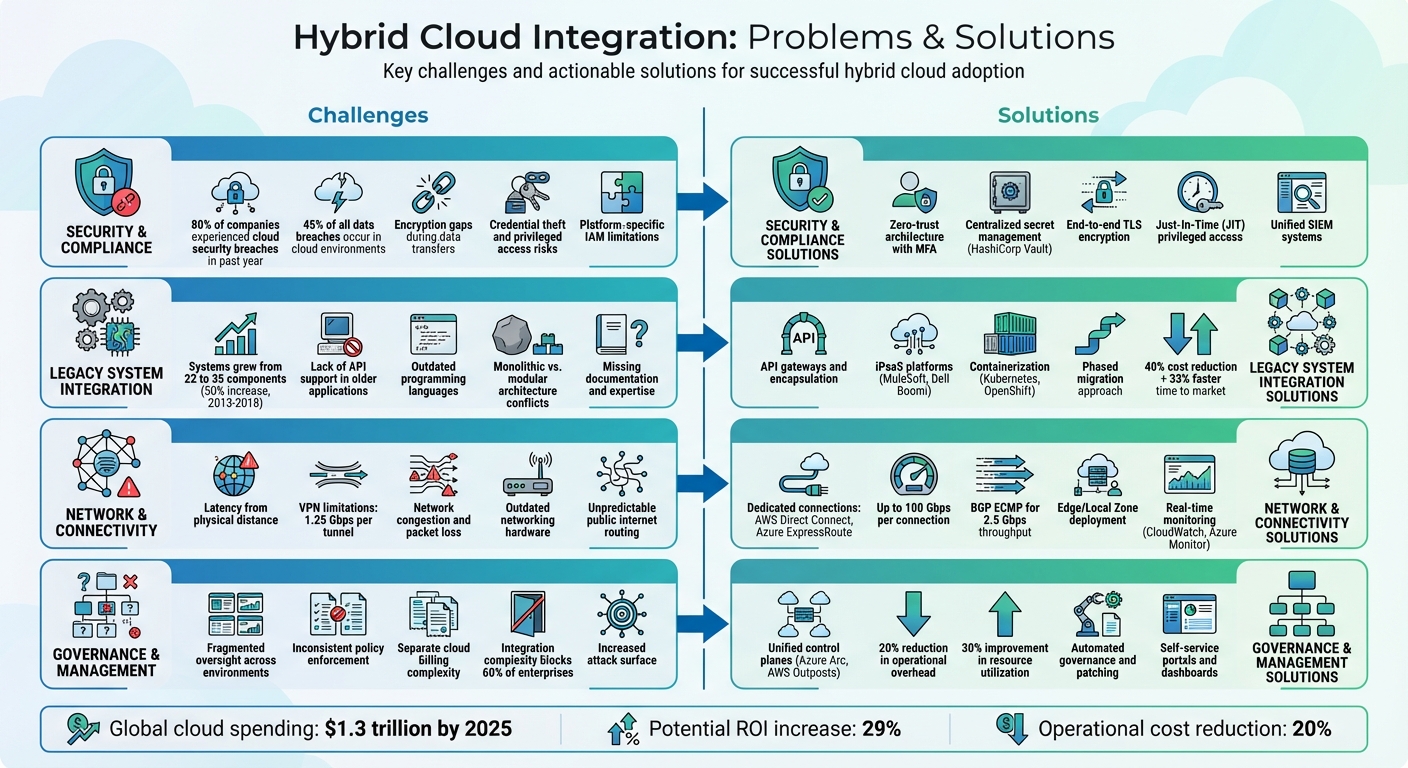
Hybrid Cloud Integration Challenges and Solutions Comparison Table
The Truth About Hybrid Cloud Integration
Data Security and Compliance Risks
When it comes to hybrid cloud environments, security gaps can lead to serious risks. Since hybrid setups rely on integrating various systems, they often use different security tools and policies, which can create vulnerabilities. For instance, AWS IAM roles are designed to work exclusively within AWS and cannot manage access to on-premises servers or resources in other public clouds. These integration challenges leave room for specific security threats, which we’ll break down below.
Common Security Risks
One major risk is data transfers without proper encryption, leaving sensitive information exposed. Gui Alvarenga, Sr. Product Marketing Manager at CrowdStrike, explains:
Hybrid cloud security is the collection of tools and processes designed for the protection of data and infrastructure that combines elements of private cloud, public cloud, and on-premises infrastructure into a unified architecture.
Credential theft is another pressing issue. Microsoft highlights this concern:
Business asset security depends on the integrity of the privileged accounts that administer your IT systems. Cyber-attackers use credential theft attacks to target administrator accounts… to try to gain access to sensitive data.
The numbers speak for themselves: 80% of companies reported a cloud security breach in the past year, and nearly 45% of all data breaches occur within cloud environments.
Another challenge comes from native secret managers, which are often restricted to their own platforms. This creates complexity when managing secrets across different systems and makes secret rotation more cumbersome. On top of that, compliance regulations like GDPR, HIPAA, or CCPA require organizations to clearly document where sensitive data is stored and who has access to it. Addressing these challenges demands a multi-layered approach, which we’ll explore next.
How to Reduce Security Risks
To strengthen security in hybrid cloud environments, start with a zero-trust architecture. This means verifying every access request, no matter where it originates, and implementing multi-factor authentication (MFA) for all users, especially those with administrative or executive privileges. Using Privileged Identity Management (PIM) for just-in-time provisioning ensures administrative access is granted only when needed, minimizing opportunities for attackers. Microsoft also advises keeping at least two cloud-only emergency access accounts with Global Administrator roles to prevent complete lockouts during system issues. These accounts should bypass standard MFA but must be closely monitored.
For highly sensitive tasks, consider using Privileged Access Workstations (PAWs) – dedicated, secure systems designed to guard against phishing and keystroke logging. Centralized secret management tools, such as HashiCorp Vault, can simplify managing credentials across your hybrid infrastructure. To secure data in transit, use TLS for API traffic and MACsec for high-speed private connections. Regularly audit your cloud configurations with CSPM tools, and centralize threat detection by streaming all logs into a unified SIEM system like Microsoft Sentinel.
| Security Component | Challenge in Hybrid Cloud | Recommended Solution |
|---|---|---|
| Identity Access | Provider-specific IAM roles don’t span environments | Unified identity platforms (e.g., Microsoft Entra ID) and SSO |
| Data Protection | Encryption gaps during inter-cloud transmission | End-to-end TLS encryption and MACsec for private links |
| Secrets | Platform-limited secret managers | Centralized tools (e.g., HashiCorp Vault) |
| Governance | Lack of visibility across distributed systems | CSPM tools and unified SIEM |
| Privileged Access | Standing admin rights increase attack surface | Just-In-Time (JIT) access and PIM |
Equifier offers cybersecurity risk assessments and compliance solutions tailored to hybrid environments. Their expertise lies in identifying vulnerabilities and implementing controls to meet regulatory standards. By combining cloud-native features with third-party security tools, they help ensure your sensitive data stays secure across all platforms. These measures not only address existing risks but also align with your broader hybrid cloud strategy.
Integration Complexity and Legacy System Compatibility
Legacy System Challenges
Bringing legacy systems into the modern cloud ecosystem isn’t a straightforward task. These older systems tend to be monolithic and tightly intertwined, while today’s cloud platforms favor modular, distributed architectures. This fundamental difference makes integration a highly technical and challenging process. It’s not as simple as plugging one into the other – significant modifications are often required.
One of the biggest hurdles is the lack of API support in legacy applications. Many of these systems rely on rigid, outdated data formats, creating isolated data silos that block real-time integration. Without standardized interfaces, even basic communication between systems demands custom development. To make things worse, legacy systems often run on outdated programming languages and unsupported frameworks, further widening the gap. Between 2013 and 2018, the number of systems or components involved in an average web or mobile transaction grew from 22 to 35 – a rise of over 50%.
Adding to these technical challenges is the lack of updated documentation and the dwindling number of personnel who understand these decades-old systems. When critical knowledge is locked away in the minds of retiring employees, mapping essential functionalities for migration becomes an almost insurmountable task. Martín Mandujano from Chakray sums it up well:
"The integration of legacy systems into hybrid cloud environments is not simply a matter of technical connectivity but a process that requires a holistic view of enterprise architecture, security, interoperability, and scalability."
Overcoming these challenges requires not only technical solutions but also a strategic approach tailored to the unique nature of legacy systems.
Integration Solutions
To tackle these integration challenges, an API-first approach is a smart starting point. By wrapping legacy systems in modern interfaces using API gateways, you can enable communication between old and new systems without altering the legacy code itself. This method, known as encapsulation, is particularly useful when rewriting the entire system isn’t practical.
Another effective option is leveraging Integration Platform as a Service (iPaaS) tools like MuleSoft, Dell Boomi, or Azure Logic Apps. These platforms centralize and streamline connections across hybrid environments, making integration more manageable. For instance, organizations using MuleSoft have reported cutting monitoring time in half and reducing operational delays by up to 60%.
Containerization tools like Kubernetes or OpenShift offer another layer of flexibility by dynamically managing workloads across on-premises and cloud environments. For a more gradual modernization, consider breaking down monolithic applications into smaller, independent microservices. This approach helps improve scalability and speeds up integration efforts.
| Strategy | Description | Best For |
|---|---|---|
| Encapsulation | Wrapping the legacy system in an API or gateway | Quick integration without altering the core legacy code |
| Re-platforming | Migrating to the cloud with minor optimizations | Gradual updates to legacy infrastructure |
| Refactoring | Restructuring code without changing its behavior | Improving performance while keeping functionality intact |
| Replacement | Full migration to a cloud-native platform | Outdated systems that are costly or pose security risks |
Instead of attempting a "big bang" migration, opt for a phased approach. Gradually upgrade or replace parts of the legacy system to minimize disruption and reduce risks. Reverse engineering can also help map critical functionalities of older systems, ensuring essential features aren’t lost during the process. Businesses that have successfully implemented hybrid cloud systems report a 40% reduction in running costs and a 33% faster time to market.
For organizations navigating these complex transitions, Equifier offers IT services and staffing solutions. Their team specializes in finding professionals skilled in both legacy systems and modern cloud platforms. Additionally, their IT consulting services provide tailored guidance on selecting the right tools and strategies for seamless integration. By combining expertise with practical solutions, Equifier helps businesses embrace hybrid cloud systems without disrupting existing operations.
Network Connectivity and Latency Problems
What Causes Connectivity Issues
When it comes to hybrid cloud setups, network connectivity plays a key role in ensuring smooth performance. One of the biggest challenges is latency, which often stems from the physical distance between on-premises data centers and cloud regions. Even small delays can build up over time, dragging down application performance. Every router or switch your data passes through adds to this latency, and when your hybrid infrastructure involves multiple routing paths, the response times can take a serious hit. These issues highlight the need for focused performance improvements.
The type of connection you use also has a major impact on latency. For example, relying on the public internet through VPNs can lead to unpredictable latency and jitter because routing paths frequently change. On the other hand, private fiber connections offer much more stable and consistent performance. To put it in perspective, standard VPNs typically cap out at 1.25 Gbps per tunnel, whereas dedicated cloud interconnects can scale up to an impressive 100 Gbps per connection.
Another common issue is network congestion, which happens when the volume of data exceeds your infrastructure’s capacity or the bandwidth of a specific link. This creates bottlenecks, delaying or even dropping packets. Outdated networking hardware – like routers, switches, and firewalls – often struggles to handle the high traffic loads of modern cloud environments, making matters worse. To complicate things further, many organizations lack comprehensive monitoring tools, making it tough to pinpoint whether the bottleneck lies in the local network, the ISP, or the cloud provider.
How to Improve Network Performance
If you’re running production workloads that demand high speed and reliability, consider using dedicated connectivity services like AWS Direct Connect, Azure ExpressRoute, or Google Cloud Interconnect. These options provide lower latency, minimal jitter, and consistent bandwidth – essential for keeping data in sync. If you’re stuck with internet-based connections, accelerated VPN services can help by routing your traffic through global accelerator networks instead of the congested public internet.
Centralizing connection management can also reduce errors and improve performance. Tools like AWS Transit Gateway or Google Cloud Network Connectivity Center simplify hybrid environment configurations, cutting down on mistakes that could lead to performance issues. Additionally, implementing BGP Equal-Cost Multipath (ECMP) allows you to split traffic across multiple VPN tunnels or Direct Connect links, boosting throughput to as much as 2.5 Gbps per attachment.
For latency-sensitive applications, deploying them in Local Zones or edge locations can minimize unnecessary hops. Subnetting high-traffic endpoints into groups can further reduce latency. To stay ahead of potential problems, monitor metrics like TunnelDataIn/Out and ConnectionBpsIngress/Egress using tools such as Amazon CloudWatch or Azure Monitor. This helps identify oversubscribed links before they become critical issues.
For businesses tackling these challenges, Equifier’s IT services offer tailored solutions to optimize your infrastructure. Their team specializes in configuring on-premises routers and cloud endpoints to ensure high-performance routing. Whether you need advice on selecting the best connectivity option or help setting up advanced monitoring systems, Equifier provides hands-on support to meet your network needs effectively.
sbb-itb-05efa2a
Governance, Scalability, and Management Hurdles
Governance and Scalability Challenges
In hybrid cloud setups, fragmented oversight often leads to inconsistent policy enforcement. When teams work in isolated silos across on-premises data centers and various public clouds, it becomes challenging to maintain uniform management practices. This lack of cohesion complicates efforts to enforce security, compliance, and operational policies consistently across all environments.
As IBM Consulting aptly states:
The hybrid cloud journey’s archenemy is complexity.
The diversity of platforms not only slows down return on investment (ROI) but also increases the security risks by broadening the attack surface. On top of that, managing separate cloud bills adds layers of complexity to financial governance.
Another hurdle is optimizing resource provisioning and utilization through strategies like cloud bursting. Without a unified operating model, coordinating resources effectively across different environments becomes a constant struggle. Tackling these challenges requires a more integrated approach to management, which is discussed in the following section.
Management Solutions
Platforms like Azure Arc and AWS Outposts offer a solution to fragmented oversight and scalability issues by providing a unified control plane. These tools allow you to oversee on-premises, edge, and multicloud resources through a single interface. This not only ensures consistent policy enforcement but also enables scalable resource management. By consolidating IT processes, such platforms can reduce operational overhead by as much as 20%.
Automation plays a key role in simplifying management tasks. Tools such as Azure Policy and AWS Systems Manager can automate patching and state management processes. Additionally, self-service portals and real-time dashboards can improve resource utilization metrics by up to 30%.
Equifier offers staffing services to bring in IT experts who can help implement unified management frameworks. Their cloud optimization solutions provide hands-on support for configuring these platforms and setting up automated governance systems, making hybrid cloud management far more efficient.
Building a Successful Hybrid Cloud Strategy
Steps for Success
When crafting a hybrid cloud strategy, it’s essential to align technical decisions with your business goals. Whether your focus is on enhancing customer experiences, meeting regulatory standards, or reducing operational expenses, having a clear vision ensures your infrastructure supports these objectives effectively.
Start by evaluating your current systems. Map out how your applications, databases, and APIs interact to prevent integration issues down the line. This step is crucial – over 60% of enterprises identify integration complexity as a major obstacle to fully leveraging their hybrid cloud investments.
Define measurable, time-specific KPIs. Examples could include achieving 99.99% uptime, cutting provisioning times, or lowering operational costs. To simplify management, consider platforms like Azure Arc or AWS Outposts, which provide a unified view of your environments. These tools help reduce fragmentation and maintain consistent policies across your infrastructure.
Security should be a priority from the outset. Adopting a zero-trust framework ensures that every access request is verified, and all data is encrypted, regardless of its source. Begin with a pilot project on a non-critical workload to establish a blueprint for future migrations.
By following these steps, you’ll be better positioned to navigate the complexities of hybrid cloud adoption and set the stage for expert support.
How Equifier Supports Hybrid Cloud Success
Expert guidance can make all the difference when tackling the challenges of hybrid cloud integration. Equifier offers tailored support in three key areas: talent acquisition, cybersecurity consulting, and IT infrastructure optimization.
Their recruiting and staffing solutions connect you with IT professionals who have the cross-platform skills needed to manage both on-premises data centers and cloud environments. This blend of expertise is essential for hybrid strategies that require balancing legacy systems with modern cloud technologies.
In the realm of security, Equifier conducts comprehensive risk assessments and provides compliance solutions tailored to hybrid environments. They help identify vulnerabilities across your distributed infrastructure and offer practical solutions to address them. Their IT consulting services include hands-on assistance with configuring unified management platforms, automating governance systems, and optimizing cloud resources. This approach helps you sidestep the complexity that often hinders hybrid cloud initiatives. As the IBM Institute for Business Value aptly puts it:
The hybrid cloud journey’s archenemy is complexity.
Conclusion
Hybrid cloud integration comes with its fair share of challenges – think security risks, legacy systems that don’t play nice, network delays, and governance headaches. But here’s the thing: these hurdles aren’t insurmountable. Success lies in careful planning, unified management tools, and tapping into the right expertise.
The organizations that get it right don’t treat hybrid cloud as a random collection of tech choices. Instead, they see it as a purposeful business strategy. They align their infrastructure with clear goals, like meeting GDPR or HIPAA compliance standards. Complexity, which IBM Consulting calls the "archenemy" of hybrid cloud adoption, is tackled head-on with standardized tools, automated workflows, and centralized oversight.
With global cloud spending expected to top $1.3 trillion by 2025, businesses that address integration challenges early could see a 29% boost in returns and a 20% reduction in operational costs. On the flip side, fragmented approaches can lead to ballooning costs and security vulnerabilities – something no organization can afford.
The solution? Aligning technology with human expertise. Whether it’s implementing zero-trust security models, updating outdated applications, or setting up governance across diverse environments, having skilled professionals who understand both on-premises systems and cloud platforms is essential for smooth integration.
This is where Equifier steps in. They provide IT experts with proven cross-platform skills, conduct tailored cybersecurity assessments for hybrid setups, and optimize infrastructure with hands-on solutions. Their comprehensive approach doesn’t just address hybrid cloud challenges – it turns them into strategic opportunities for growth and efficiency.
FAQs
What are the most important security measures for hybrid cloud environments?
To protect hybrid cloud environments, you need a well-rounded strategy that safeguards data, applications, and infrastructure across both on-premises and cloud systems. Start by implementing strong identity and access management (IAM). This ensures that only authorized users can access sensitive resources, reducing the chances of unauthorized access and bolstering security.
Next, prioritize continuous monitoring and logging to detect and address potential security issues as they arise. Regular vulnerability assessments are crucial, alongside measures like network segmentation and encryption – both for data at rest and in transit – to secure your systems and sensitive information. Additionally, a clearly defined incident response plan tailored to hybrid cloud environments is essential. Such a plan helps you recover quickly from incidents while staying compliant with regulations.
By combining IAM, monitoring, encryption, and a robust incident response plan, you can effectively shield your hybrid cloud setup from ever-changing security threats.
What are the best ways to integrate legacy systems into a hybrid cloud environment?
Integrating older systems into a hybrid cloud setup can be tricky, but there are smart ways to make it work smoothly. One effective method is using middleware or integration platforms. These tools act as a bridge, helping older systems communicate with modern cloud services by supporting various protocols and APIs. The best part? They reduce the need for costly and time-consuming system overhauls.
Another strategy is to modernize legacy systems step by step. For instance, you can wrap them with APIs or connectors to enable secure and efficient data sharing. This way, your legacy systems can stay operational while still fitting into your hybrid cloud framework. Throughout this process, it’s crucial to prioritize data security, compliance, and performance to ensure everything runs smoothly without interruptions.
For a more sustainable solution, opt for flexible and scalable options that support real-time data synchronization. This approach not only keeps legacy systems functional but also allows them to grow and adapt alongside your cloud infrastructure, keeping your hybrid setup efficient and ready for the future.
How can network latency be minimized in hybrid cloud environments?
Minimizing network latency in hybrid cloud setups demands careful planning and the right tools. A key tactic is to strategically place cloud resources by connecting to public cloud facilities that are closer to your private data centers. This shortens the physical distance data has to travel, which naturally helps reduce latency.
Another effective method is leveraging dedicated connectivity options, such as private fiber connections or secure VPN tunnels. These solutions not only offer higher bandwidth but also provide more stable connections, making them ideal for improving performance. Customizing these options to suit specific workload requirements can lead to even better outcomes. On top of that, regularly monitoring network performance and choosing the right connectivity architecture – whether it’s edge consolidation or full-mesh configurations – can significantly boost reliability and address latency challenges.
By adopting these strategies, businesses can streamline their hybrid cloud operations and enhance performance across their systems.