








If you need to sort cyber risks fast, use qualitative assessment. If you need to defend a budget, insurance limit, or board decision, use quantification.
I’d sum it up this way: one method gives you labels like low, medium, and high. The other gives you loss estimates in U.S. dollars, such as $900,000 in annual loss exposure or a breach cost range tied to one scenario. That difference matters when the average U.S. data breach cost can reach $10.22 million.
Here’s the short version:
- Qualitative assessment helps me rank many risks fast.
- Cyber risk quantification helps me tie risk to money, not colors.
- Qualitative works well for compliance reviews, risk registers, and broad sorting.
- Quantification works well for control spend, cyber insurance, ROI, and board reporting.
- Many teams use both: first to sort, then to model the few risks tied to major spending.
What I’d look at before choosing a method:
- Decision type: Am I sorting work, or approving spend?
- Data quality: Do I have incident, control, and business impact data?
- Team skill: Can I build and explain a model?
- Scope: Do I need coverage across many risks, or depth on a few?
- Audience: Is this for security staff, auditors, a CFO, or the board?
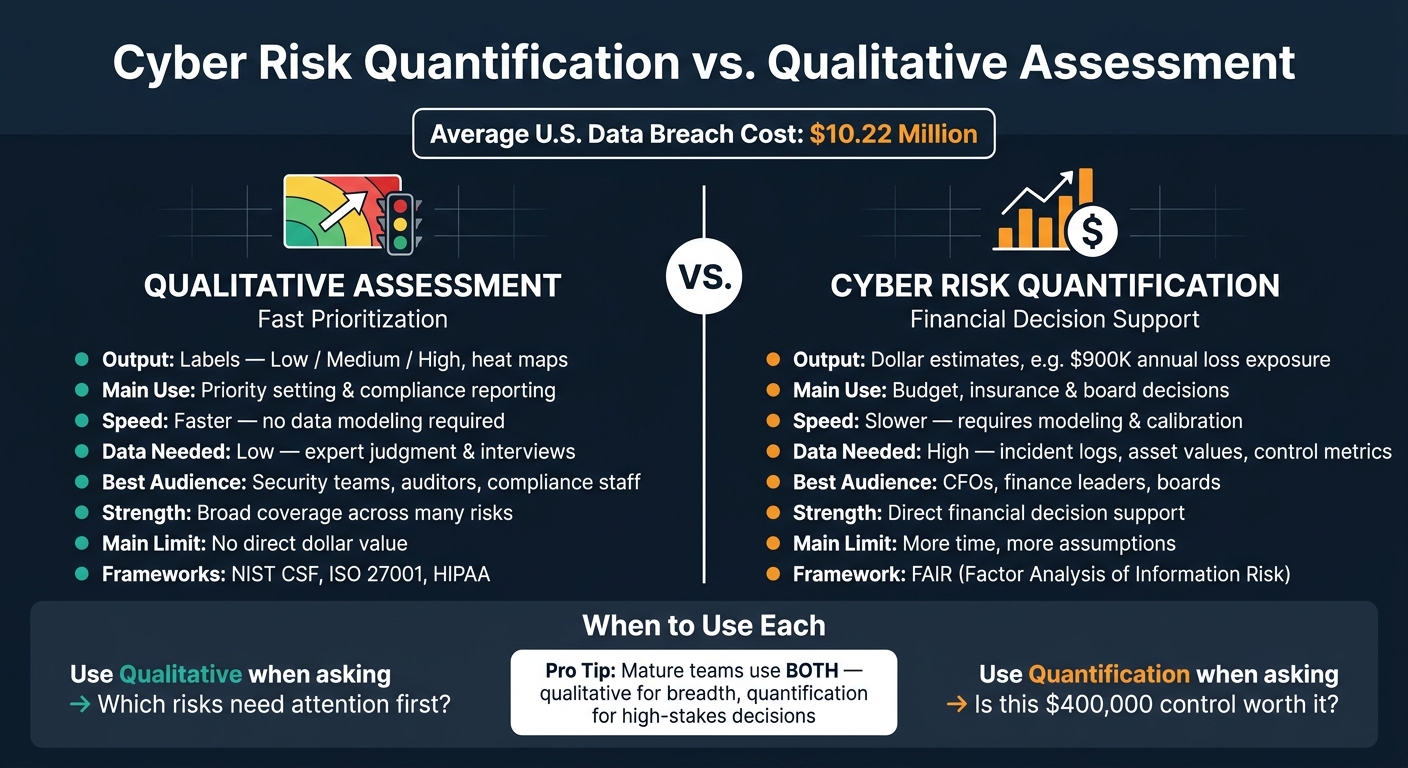
Cyber Risk Quantification vs. Qualitative Assessment: Side-by-Side Comparison
GRC DEEP Dive on Cyber Risk Quantification with 20+ Year CISO
sbb-itb-05efa2a
Quick Comparison
| Criteria | Qualitative Assessment | Cyber Risk Quantification |
|---|---|---|
| Output | Labels, heat maps, risk statements | Dollar estimates, ranges, loss distributions |
| Main use | Priority setting | Budget and insurance decisions |
| Speed | Faster | Slower |
| Data needed | Low | Higher |
| Best audience | Security, audit, compliance teams | CFOs, finance leaders, boards |
| Strength | Broad coverage | Financial decision support |
| Main limit | No direct dollar value | More work and more assumptions |
So if you’re asking, “Which risks should I look at first?” I’d start with qualitative scoring. If you’re asking, “Is this $400,000 control worth it?” I’d move to quantification.
Qualitative Cyber Risk Assessment: Fast Prioritization Using Descriptive Ratings
Qualitative assessment is often the first step in cyber risk work across U.S. organizations. It doesn’t need historical loss data or a financial model. Instead, it leans on structured expert judgment to answer a simple question: which risks need attention first?
How Qualitative Assessments Are Built
The process usually begins with stakeholder interviews. Teams talk with business owners, system owners, risk and compliance leaders, IT operations staff, and business unit managers. These conversations help surface which systems matter most, which threats are most likely, and where controls may be weak. After that, teams often run threat modeling workshops to map out attack paths that could happen in practice, like ransomware hitting an ERP system or a phishing campaign aimed at finance staff.
Next comes the review of policies and procedures. Assessors look at whether documented controls, such as access management policies, incident response plans, and backup procedures, exist and whether people are following them in day-to-day work. Vulnerability scan reports and configuration baselines add a technical check against what people said in interviews. Once all of that is in hand, teams score each risk with a likelihood-and-impact matrix, often a 5×5 grid. That grid combines five likelihood levels, from rare to almost certain, with five impact levels, from minor to severe. Each pairing leads to a rating such as low, medium, high, or critical. The results are then often shown in a heat map with red, yellow, and green zones that leadership can scan in seconds.
The final output usually includes a ranked risk register. That register lists each scenario with its score, owner, current controls, and recommended next steps. Teams also write narrative risk statements in plain business language. For instance, instead of showing only a score, the write-up might say that a ransomware attack on the claims processing platform could stop operations for several days, delay payouts, and hurt customer trust. That tends to land better with a board member than a number on its own.
Strengths and Limits of Qualitative Assessment
The biggest upside is speed. A qualitative review can cover many assets and threat scenarios in a short period, without heavy data collection or complex financial work. It’s also easy for non-technical stakeholders to join in. People can take part in workshops and make sense of heat maps without having to decode statistics. That’s why this approach works well for annual enterprise risk reviews, compliance-driven assessments under frameworks like NIST CSF or HIPAA, and moments when leadership needs a quick read on the biggest exposures.
But there are trade-offs. These ratings depend a lot on who is in the room. Two teams looking at the same ransomware scenario can score it very differently if they start from different assumptions or have different levels of experience. And while a high rating shows urgency, it doesn’t tell a CFO what to put in the budget. There’s no dollar figure behind the color. That becomes a sticking point when leadership is weighing a large spending request or any budget call where $500,000 versus $5,000,000 makes a big difference.
| Attribute | Qualitative Assessment |
|---|---|
| Speed of execution | Fast – workshops and interviews, no data modeling required |
| Ease of communication | High – heat maps and narratives work well for executives |
| Data requirements | Low – expert judgment, policies, and basic technical inputs |
| Broad risk coverage | Strong – many assets and threats can be reviewed in one cycle |
| Financial precision | Weak – ratings don’t translate directly to dollar estimates |
| Scoring consistency | Variable – depends on assessor experience and defined criteria |
| Support for budget decisions | Limited – hard to tie ratings to specific spending requests |
| Regulatory reporting fit | Good – aligns with NIST CSF, ISO 27001, and similar frameworks |
That consistency issue can be improved with discipline. Clear anchors for each rating level help a lot. Say a team defines major impact as loss of access to the primary customer portal for more than 24 hours. Now people aren’t guessing what "major" means. Some organizations also connect qualitative ratings to rough financial bands. For example, they may note that a major impact often lines up with $500,000 to $5,000,000 in potential loss. That doesn’t replace a quantitative model, but it does help connect risk language to budget talks.
Cyber Risk Quantification: Financial Estimates to Support Investment Decisions
If qualitative assessment ranks risk, quantification puts a dollar figure on it. Instead of sorting threats into labels like high or medium, quantitative modeling translates them into financial exposure, usually as expected annual loss in USD. That answers the question qualitative ratings leave hanging: how much money is at stake?
What Goes Into a Quantified Cyber Risk Model
Most teams rely on a structured model so estimates don’t drift from one scenario to the next. FAIR is the most common framework for this work. FAIR breaks cyber risk into two main variables:
- Loss Event Frequency (LEF): how often a harmful event is expected to happen each year
- Loss Magnitude (LM): the financial impact of each event
Loss magnitude covers direct costs, like response and recovery, along with indirect costs, like legal exposure, churn, and reputational harm.
To estimate those variables, teams pull from several data sources: internal incident logs, asset valuations tied to revenue or business criticality, business interruption estimates from continuity planning data, threat intelligence on attack frequency, and control performance metrics such as patch rates and phishing failure rates. When the data is incomplete – and it often is – teams use calibrated expert judgment in workshops to set low, most-likely, and high ranges.
From there, teams run Monte Carlo simulations to turn those ranges into an annual loss distribution. So leadership doesn’t get a single neat number. They get a range, which is usually a better fit for how risk works in the first place.
Where Quantification Adds the Most Value
This approach pays off when leaders need to weigh risk reduction against cost. Control prioritization is a good example. Say a model shows a baseline annual loss of $6 million for a credential theft scenario. If a planned multi-factor authentication upgrade cuts that to $2.5 million, the company can stack a $3.5 million risk reduction against a $1 million annual control cost. That’s a much clearer business case than a color on a heat map.
The same idea carries over to cyber insurance. Quantified loss distributions can help answer whether $10 million or $50 million in coverage makes sense for your organization’s exposure profile. Board reporting also tends to land better when scenario loss ranges are tied to actual business operations instead of red-yellow-green charts.
There is a tradeoff, of course. Quantification takes more time, needs input from multiple teams, and works best when it reports ranges instead of fixed numbers. Otherwise, you get false precision, and that’s where people start trusting the math more than the assumptions behind it.
| Attribute | Quantitative Assessment |
|---|---|
| Speed of execution | Slower – requires data gathering, modeling, and calibration |
| Ease of communication | Moderate – ranges and distributions need framing for non-technical audiences |
| Data requirements | High – incident history, asset values, control metrics, and external benchmarks |
| Financial precision | Strong – outputs in USD with probability distributions |
| Support for budget decisions | Strong – directly links risk reduction to investment cost |
| Regulatory reporting fit | Good – defensible documentation supports audits and compliance reviews |
| Broad risk coverage | Narrower per cycle – best applied to high-priority scenarios first |
That makes quantification powerful – but not always necessary.
Cyber Risk Quantification vs. Qualitative Assessment: Direct Comparison
The choice comes down to this: do you need fast prioritization, or do you need a dollar-based answer? That’s the main split between these two methods.
Here’s how they stack up on the points business leaders care about most:
| Criteria | Qualitative Assessment | Cyber Risk Quantification |
|---|---|---|
| Output format | Descriptive labels such as Low / Medium / High or color-coded heat maps | Dollar-based estimates such as annualized loss expectancy (ALE) or loss distributions; for example, ransomware risk estimated at $750,000 ALE |
| Best for | Security teams and auditors | CFOs and boards |
| Best used for | Broad prioritization, compliance reporting, and security roadmaps | Budget justification, cyber insurance decisions, ROI analysis, and materiality assessments |
A heat map is useful for sorting work. But it doesn’t tell a CFO how much risk is left or how much money to spend to cut it.
That doesn’t mean qualitative methods are weaker. They answer broad priority questions. Quantification answers budget questions.
When to Use Qualitative Assessment and When Quantification Is Worth the Effort
Use the comparison above to match the method to the decision in front of you.
Qualitative assessment is the right default for baseline risk identification, compliance-driven reporting, vendor evaluations, and routine prioritization. It’s fast, doesn’t call for specialized modeling skills, and is easy to explain across teams.
Quantification makes sense when a financial decision hangs on the answer. For example:
- How much should we invest in this control?
- Should we increase our cyber insurance limit from $10 million to $50 million?
- Does a $400,000 investment in backup infrastructure cut ransomware exposure enough to justify the cost?
Those decisions need dollar-denominated outputs, not color codes.
If the decision involves major spending or a materiality assessment, quantify it. If the goal is to sort priorities or meet routine reporting needs, qualitative methods are often enough.
Why Many Organizations Use Both Methods
Many mature programs use qualitative assessment for breadth, then apply quantification to the smaller set of risks tied to funding or insurance decisions.
Take a U.S. healthcare provider. It may keep a qualitative risk register across all departments, then run a full quantitative model for a patient data breach scenario. That model can estimate notification, legal, regulatory, and reputational costs in dollar terms before the company decides on insurance coverage or added access controls.
A manufacturing firm might take the same approach with ransomware affecting production lines. In that case, the company can calculate potential daily output loss and use that figure to justify network segmentation spending to the CFO.
How to Choose the Right Method and Apply It
Once you’ve decided both methods matter, the next step is picking where to start. That choice usually comes down to four things: maturity, data quality, regulatory pressure, and in-house skill.
If your incident history is thin, qualitative scoring is often the better starting point. It helps teams make sense of risk even when hard numbers are limited. If you already have enough business-impact data for the scenarios tied to your biggest financial calls, quantification makes more sense. Teams with a clear risk appetite, defined roles, and steady executive reporting are also in a better spot to use quantification.
A simple rollout looks like this:
- Define scenarios in business terms.
- Standardize likelihood and impact anchors.
- Prioritize scenarios that drive spending, insurance, or disclosure decisions.
- Document event frequency, loss types, and control effects; use FAIR to structure assumptions.
- Compare annualized loss with control costs, then fund the control with the largest reduction.
If in-house skill is limited, cybersecurity consulting and specialized staffing can help speed up the move from scoring to quantification. Equifier supports that shift through cybersecurity consulting, compliance solutions, and recruiting for roles such as risk analysts, security engineers, and cloud architects.
Match the Method to the Decision You Need to Make
Use qualitative assessment for broad prioritization. Use quantification when the decision touches budget, insurance, or board-level materiality. As incident losses climb, the level of rigor you use starts to matter a lot more.
FAQs
Can small businesses use cyber risk quantification?
Yes. Small businesses can use cyber risk quantification by putting numbers on risk, then pairing that with simple labels like high, medium, or low. That gives them a clearer picture than either method on its own.
And this doesn’t have to cost a fortune. On a tight budget, a small business can start with a few practical steps: run basic vulnerability scans, build a risk list, rank the main threats, and write down each risk along with its expected impact. It’s a simple way to track what matters most and improve over time.
How much data do I need to quantify cyber risk?
You don’t need every last data point. You need enough to build a complete inventory of assets and data, including what’s sensitive and where it lives.
From there, use evidence – such as vulnerability findings, current safeguards, scans, audits, and documented findings – to measure likelihood and impact.
When should I use both methods together?
Use both when you need range and precision. Quantitative scoring helps you compare and rank risks across systems, while qualitative ratings add context that raw numbers can miss.
This matters most during complex, cascading risk events. Used together, these two methods give you a more complete view of risk and help support decisions that line up with structured frameworks like NIST.