









Picking the wrong IT staffing agency can cost you time, money, and project momentum. In the U.S., a bad hire can cost about 30% of that employee’s annual salary, and worker misclassification can lead to $10,000 to $100,000+ in penalties, taxes, and labor issues.
If I were reviewing an agency, I’d focus on four things first:
- Can they judge technical skill well?
- Can they handle U.S. compliance and worker classification?
- Can they protect candidate and client data?
- Can they show clear pricing, terms, and past results?
The 10 questions in this article help me check all of that. They cover:
- IT and cybersecurity focus
- Candidate sourcing and screening
- Fit for my business and projects
- Performance metrics and service levels
- U.S. compliance and worker classification
- Pricing, contract terms, and replacement policies
- Cybersecurity and data protection
- Account management and communication
- Results for similar roles
- Future hiring plans and tech changes
The main idea is simple: I should not judge an agency by sales claims. I should judge it by its screening process, compliance steps, data controls, contract terms, and proof from similar placements.
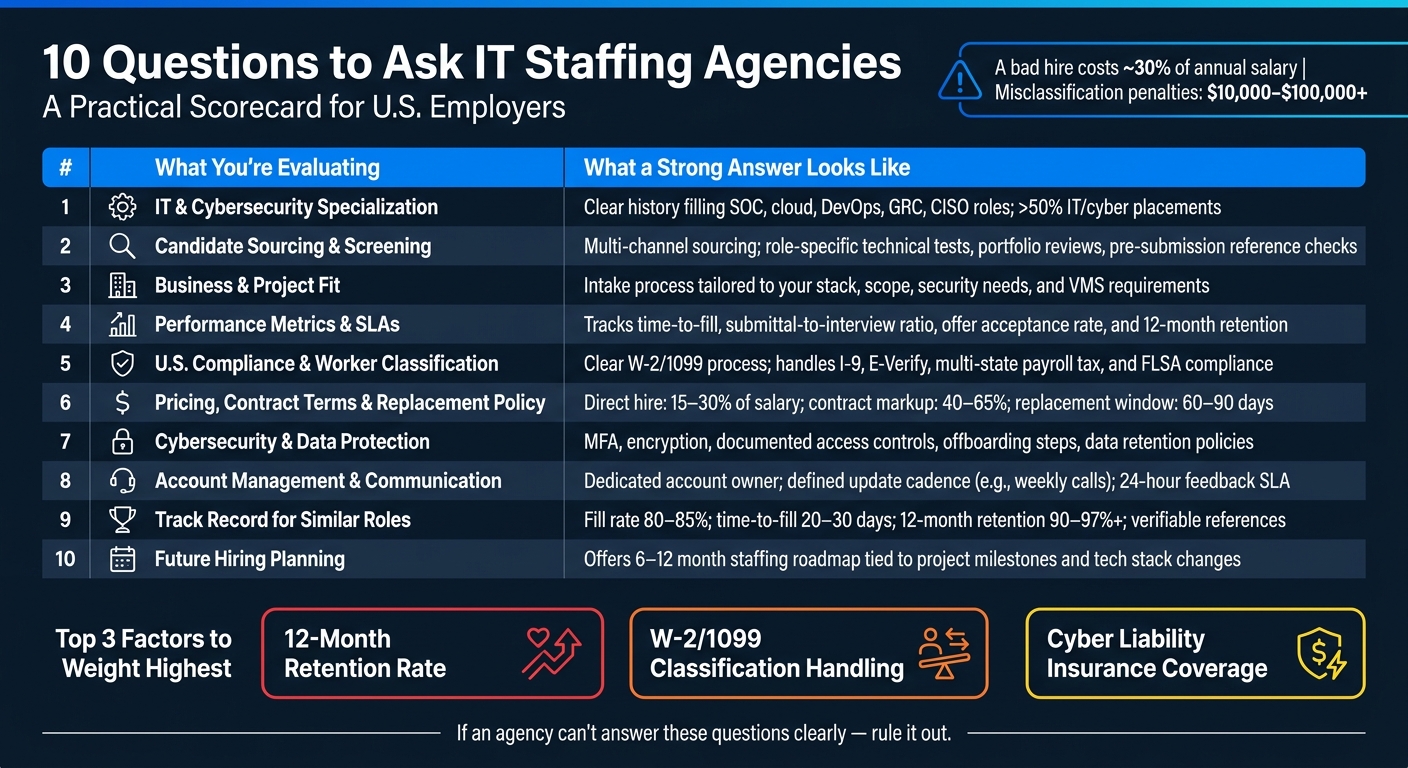
10 Questions to Ask IT Staffing Agencies: Evaluation Scorecard
10 Questions to Ask Before Choosing a Staffing Agency | Avoid Costly Hiring Mistakes in 2026
sbb-itb-05efa2a
Quick Comparison
| What I’m checking | What I want to hear |
|---|---|
| Technical focus | Clear history filling IT and cybersecurity roles |
| Screening process | More than résumé matching; role-based checks |
| Business fit | Process shaped to my stack, scope, and timeline |
| Metrics | Time-to-fill, retention, offer acceptance, ratios |
| Compliance | W-2/1099 handling, I-9, E-Verify, multi-state support |
| Pricing | Clear fees, markup, conversion terms, replacement window |
| Security | MFA, encryption, access limits, offboarding steps |
| Communication | One main contact, update cadence, escalation path |
| Track record | Case studies, references, retention data |
| Planning | Help with hiring needs 6–12 months out |
If I ask these questions early, I can spot weak agencies before I sign anything and compare firms with a simple scorecard instead of guesswork.
Why These Questions Matter for U.S. Employers
A bad hire is expensive. The U.S. Department of Labor estimates that a bad hire costs about 30% of that employee’s annual salary in direct costs alone.
Misclassification is another big problem. If a worker is treated as an independent contractor but the working setup doesn’t back that up, the result can be IRS penalties, back taxes, and state labor violations. Those costs can range from $10,000 to over $100,000, depending on how broad the issue is and how serious it gets. And if you’re hiring across state lines, things get trickier fast. One remote employee working from a new state can trigger payroll tax duties, workers’ compensation rules, and wage-and-hour compliance in that state. Multi-state payroll violations can add 5% per month, up to 25%.
For W-2 workers, the agency is usually the employer of record. That means it handles Form I-9, E-Verify, document retention, and audit response. But that doesn’t mean you’re off the hook. In joint-employment cases, authorities can ask for I-9 records for on-site workers, including contractors.
There’s also the data side of this. Staffing agencies hold Social Security numbers, IDs, and payroll records. If their encryption, MFA, or incident response is weak, your company can end up exposed too, especially when contractors can get into client systems or touch regulated data.
Before you sign anything, review the main risk areas below. Each of the 10 questions that follow ties back to one of them.
| Review Area | Key Risk If Ignored |
|---|---|
| Technical specialization | Candidates screened by keyword, not technical depth |
| Worker classification (W-2 vs. 1099) | IRS penalties, back taxes, state labor violations |
| I-9 and E-Verify compliance | Federal fines, audit exposure, work authorization gaps |
| Background checks | Insider threat risk, especially in sensitive-access roles |
| Data protection practices | Breach exposure for candidate and client PII |
| Pricing and contract terms | Hidden fees, unexpected rate increases, unclear replacement policies |
| Multi-state hiring support | Payroll tax errors, missed state labor law obligations |
Use these risk areas to judge the 10 questions that follow.
1. How Do You Specialize in IT and Cybersecurity Roles?
This question separates true IT recruiters from general staffing firms pretty fast.
A specialized IT agency should be able to say, without hesitation, which roles it fills all the time: SOC analysts, cloud security engineers, DevOps engineers, GRC specialists, incident responders, and CISOs. Not just “tech roles.” The point isn’t whether they know the buzzwords. It’s whether that focus shows up in how they source and screen people.
In the U.S., that focus matters because the cybersecurity talent gap is still huge. In Q2 2024, there were 1,509,838 cybersecurity jobs demanded but only 1,284,639 workers available to fill them. That leaves a gap of about 225,200 professionals. When the market is that tight, you don’t want a firm that starts from scratch every time. You want one with vetted candidates already in the pipeline.
A few direct questions can tell you a lot:
- What share of placements in the past 12 months were in IT and cybersecurity?
- Which platforms, cloud environments, and security frameworks do you recruit for most often?
- Who handles the technical screening?
A high percentage of IT and cybersecurity placements shows real focus. Clear answers about tools, platforms, and frameworks show they live in this space day to day. If they get vague, that’s usually your sign to keep looking.
Some agencies bring more depth because they also work in cybersecurity or infrastructure services. Equifier, for example, combines staffing with cybersecurity risk assessments, compliance solutions, and IT infrastructure optimization. That extra technical context can help with screening, especially when the role touches security, compliance, or infrastructure.
The last part is where many firms fall apart: who actually evaluates the candidate. The best agencies use former engineers or security practitioners for technical screening. That may include role-specific reviews, scenario-based tests, or certification checks. The method should fit the job, not just the résumé.
2. How Do You Source and Screen Technical Candidates?
Once you’ve nailed down the agency’s area of focus, the next step is simple: find out how they actually find people and how they check whether those people can do the job.
Good IT staffing agencies don’t depend on one source. They pull from private talent networks, LinkedIn, niche job boards, referrals, alumni groups, online communities, and direct outreach to people with the right certifications or project background. For hard-to-fill roles in cloud, cybersecurity, DevOps, and software, they should already have active pipelines in place. If they’re just posting jobs and waiting, that’s a red flag.
Screening also needs to go past a résumé scan. A polished résumé can look great and still tell you very little about how someone performs on the job. Ask whether the agency uses technical interviews, live coding tasks, role-based skills tests, portfolio or GitHub reviews, and certification checks when those checks fit the role. Then ask one more thing: how does each test connect to the actual job? That’s what helps you get a shortlist based on checked skill instead of keyword matching.
For cybersecurity, cloud, and infrastructure roles, the screening process should line up with your stack, access needs, and risk profile. That’s even more important when the role touches production systems or sensitive data.
Reference checks matter too, and they should be tied to the job, not handled like a box-ticking step. The best agencies speak with supervisors or peers who worked with the candidate directly. It’s also worth asking when those checks happen. If references are checked before submission, you can save interview time and avoid poor-fit candidates earlier in the process.
| Screening element | What a strong agency answer looks like |
|---|---|
| Sourcing channels | Uses multiple channels, not just job boards |
| Technical assessment | Role-specific, matched to seniority, and tied to the job requirements |
| Portfolio/work sample review | Used for developers and other hands-on technical roles |
| Reference checks | Job-specific, behavioral, and checked before submission when it makes sense |
| Compliance | Follows U.S. employment screening and reference-check rules |
If an agency can’t walk you through this in plain English, its screening process may be too light for specialized IT hiring. That process should then connect to the next issue: how the agency shapes sourcing and screening around your business, stack, and hiring timeline.
3. How Do You Tailor Staffing Solutions to Our Business and Projects?
Once you’ve cleared the screening step, the next thing to look at is simple: can the agency shape its process around your business?
A good agency shouldn’t run the exact same playbook for every client. It should adjust based on your tech stack, project scope, team structure, and timeline. If you’re handling a cloud migration, you’re not hiring for the same thing as a legacy system update or a zero-trust rollout. Those are different jobs, with different risks, and they call for different people.
The same goes for engagement models. Contingent search, team builds, and VMS integration each need a different approach. You should see that flexibility right away in the intake questions they ask.
That intake process tells you a lot. Before the search begins, the agency should pin down your stack, scope, security needs, engagement model, team structure, and VMS requirements.
If the intake is generic, the shortlist usually is too.
A good question to ask is this: how would they staff a zero-trust rollout or stack migration differently from a standard software role? Their answer will show pretty fast whether their customization is real or just sales talk.
4. What Metrics and Service Levels Do You Use to Track Performance?
After an agency shows it can tailor the search, the next step is simple: can it prove results? Customization means little if you can’t measure what comes from it. Ask which KPIs they track, how often they report on them, and what service levels they stand behind.
Start with a small set of core metrics:
- Time-to-fill
- Submittal-to-interview ratio
- Interview-to-offer ratio
- Offer acceptance rate
- Retention
These numbers tell you a lot. They show whether the agency is filling roles fast enough and whether it’s sending people who are a good fit, not just warm bodies. That matters even more for IT and cybersecurity hiring, where a bad match can get expensive fast. Retention deserves extra attention here. Ask what the agency does after placement to help people stick, and how it works to cut early attrition.
You should also ask whether the agency offers a defined replacement window and a no-cost replacement if a placement fails during that period.
If you use a VMS, ask whether the agency can plug into it so you can track delivery against your target metrics. Those reporting habits tell you something else too: how well the agency handles documentation and day-to-day oversight.
5. How Do You Manage Compliance and Worker Classification in the U.S.?
Performance reporting shouldn’t stop at fill rates and time-to-hire. It also needs to cover compliance and worker classification.
This is where things can get serious. Compliance tells you whether an agency can place workers legally and help shield your company from avoidable risk.
Ask how the agency classifies each role as W-2 or 1099. Then ask how it handles employer-of-record duties for contract workers. Misclassification can lead to IRS, tax, and wage-and-hour penalties, so the agency should be able to walk you through its process in plain English and confirm that it handles state labor, tax, and payroll duties on your behalf.
You should also ask what its screening process includes. I-9, E-Verify, work authorization, and background checks should be standard, not add-ons.
For multi-state hiring, the agency should manage state labor, payroll tax, and onboarding rules across each location.
And if you use a VMS, make sure the agency can integrate with it.
Once compliance is clear, you can move on to pricing, contract terms, and replacement policies.
6. What Are Your Pricing Models, Contract Terms, and Replacement Policies?
After compliance, money and contract terms usually decide whether the deal still makes sense. An agency can check every legal box and still be too expensive, too rigid, or packed with fine print. So yes, read the contract as closely as you read the worker classification rules.
In the U.S., IT staffing agencies usually work with four pricing models. Direct hire placements often cost 15%–30% of the candidate’s first-year base salary, and 20% is a common reference point. Contract and contract-to-hire roles are usually billed through an hourly bill rate with markup. That markup covers payroll taxes, benefits, insurance, and the agency’s margin, and for IT roles it often lands around 40%–65%. Fixed-fee or project-based pricing tends to fit work with a clear scope, like a security assessment or a short cloud migration. The main thing to watch is the total cost, not just the number in the pitch.
Look at the full 6–12 month cost of each option instead of comparing fee percentages alone. Also ask what is already included in the fee. Screening, onboarding, and licenses can change the math fast. A simple way to avoid surprises is to ask for an itemized breakdown for a sample role before you sign.
| Pricing Model | Typical Cost | Best For |
|---|---|---|
| Direct hire (contingency) | 15%–30% of first-year salary | Permanent IT/cybersecurity roles |
| Contract (hourly bill rate) | 40%–65% markup on pay rate | Project-based or flexible staffing |
| Contract-to-hire | Hourly billing + conversion fee (10%–25%) | Evaluating candidates before committing |
| Fixed-fee / project-based | Negotiated per scope | Defined deliverables with clear timelines |
When you review contract terms, pay close attention to termination notice, conversion fees, and billing cycles. Standard termination notice is often 1–2 weeks. Most agencies bill weekly or biweekly. For temp-to-hire setups, conversion fees usually fall between 10%–25% of first-year salary. Many agencies lower or remove that fee after the contractor hits a set hours mark, often 520 hours worked.
The replacement guarantee matters too, and this is where small wording changes can cost a lot. Be clear on whether the policy gives you a free replacement, a prorated refund, or something narrower. Warranty periods usually last 60–90 days from the start date. If the role is hard to fill, it’s smart to ask for a longer window. Just as important, pin down what cancels the guarantee, such as layoffs, role changes, or a company reorg.
Once pricing and terms are nailed down, the next step is making sure the agency handles candidate and client data with care.
7. How Do You Address Cybersecurity and Data Protection During Staffing Engagements?
Once compliance is covered, the next thing to check is how the agency protects data and the systems its contractors may use. This matters for a simple reason: staffing firms often handle candidate PII and, in some cases, interact with client systems. That should be part of your review.
Get specific. Ask who can access candidate files, how those files are stored, and when they are deleted. Also ask whether the agency uses encryption, MFA, and set data retention policies.
Before a contractor gets access, spell out exactly what they can use:
- Systems
- Data
- Permissions
For sensitive roles, dig a bit deeper. Ask how the agency restricts access, separates credentials, and removes access when the engagement ends. That process should be written down before the first start date.
If the agency also offers cybersecurity services, that may point to stronger internal controls. But the main thing is still the paperwork and the process: documented access rules, retention policies, and offboarding steps. Clear security controls can also make day-to-day coordination a lot smoother.
8. What Does Your Account Management and Communication Process Look Like?
Once access and offboarding are set, the account process has a direct effect on how fast problems get handled. A good IT staffing partner gives you one main owner for updates, approvals, and escalation.
Ask this early: Who owns day-to-day communication, and what are the account manager’s, recruiter’s, and escalation contact’s responsibilities?
Your contact team should know your stack well enough to translate what you need, spot risk, and keep feedback clear and accurate.
Before you sign anything, put the update cadence and channel in writing. That might mean weekly calls, plus updates by email or Slack. You should also confirm the response-time standard for candidate feedback. For example, if they expect feedback requests to be answered within 24 hours, that should be spelled out from the start.
It also helps to map out the escalation path ahead of time. If your main contact is out, can issues go straight to senior leadership? That matters even more if a candidate withdraws or your hiring needs shift mid-process.
That communication rhythm should show up in delivery results.
9. Can You Show Results for Similar IT and Cybersecurity Placements?
Once you’ve had the initial conversation, ask for proof.
What you need to know is simple: has this agency filled roles like yours, and can it show the results? Then stack those results up against the market.
Ask for 2–3 case studies that match your role type, industry, and hiring model, whether that’s contract, contract-to-hire, or direct hire. A case study about a SOC analyst placement for a healthcare organization tells you a lot more than a broad claim about placement volume. Zero in on the numbers that matter:
- Candidates submitted
- Time-to-fill
- Interview-to-offer ratio
- Retention
If the agency can’t share client names, anonymized case studies can still help. But they need enough day-to-day detail to show the work was actually similar to yours. Skip vague win stories. Look for measurable outcomes.
Benchmarks help here. In the U.S., IT staffing fill rates tend to land around 70%–75%, while strong agencies hit 80%–85%. Average time-to-hire is about 41 days, and top performers close roles in 20–30 days. For direct-hire and contract-to-hire roles, 12-month retention of 90%–97%+ is a strong mark. Ask the agency how its own numbers line up with those figures.
For cybersecurity roles, get specific. Ask for placements tied to SOC analysis, incident response, GRC, IAM, or cloud security – not just general IT support. Also ask what share of the agency’s placements over the past 12 months were cybersecurity-specific, and whether those numbers are split out by role type.
Then verify it. Ask for a recent client reference and confirm that the agency:
- Understood the technical requirements
- Submitted accurate shortlists
- Delivered hires who were still performing 6 to 12 months later
One glowing story doesn’t tell you much. Patterns across references do. If the agency won’t share recent, similar references, that’s a red flag.
10. How Do You Plan for Our Future Hiring Needs and Technology Changes?
Past placements matter. But what matters just as much is whether an IT staffing agency can help you prepare for what’s coming next.
The best firms don’t just react when a role opens. They help you look 6 to 12 months ahead and map hiring to where your team is going. That’s the point of this question: can the agency do more than fill seats? Can it help with workforce planning before gaps turn into fire drills?
If an agency has consulting experience, that usually helps. It means they’re more likely to connect hiring plans to your tech stack, migration timeline, and security roadmap. When they understand your technical direction, they can spot skill gaps early. For example, if you’re moving through a legacy modernization project, they should see when demand may shift from maintenance roles to cloud or zero-trust talent. That kind of forward view should also show up in how they track new skills entering the market.
It’s also smart to ask how they monitor tool changes and hiring trends. Do they use partner networks to keep up with new platforms and market movement? Recruiters with backgrounds in software engineering or IT consulting are often better at screening people for changing roles in AI, ML, and cybersecurity.
Ask the agency if it can build a 6–12 month staffing plan tied to project milestones, not just headcount requests. That plan should cover:
- Full-time hires
- Contract resources
- Hard-to-fill roles, ranked by priority
Once you have that, you can compare agencies in a much clearer way: how far ahead they plan, what mix of roles they can support, and how fast they can deliver.
Comparison Tables to Use When Reviewing Agencies
These tables help you compare agencies side by side on capability, cost, and risk. Instead of relying on gut feel, you can turn the 10 questions into a simple decision tool for IT and cybersecurity staffing agencies.
The idea is simple: review each agency’s answers, then score them in a way that makes apples-to-apples comparison easier.
Table 1: Capabilities & Fit
| Evaluation Area | What to Look For | Agency A | Agency B | Agency C |
|---|---|---|---|---|
| Sourcing Reach | National reach across the U.S., large candidate network, VMS integration | |||
| Technical Vetting | Recruiters with a strong understanding of cloud infrastructure, AI/ML, SaaS, and cybersecurity | |||
| Staffing Models | Contingent Search, Contract Resources, Executive Search, Team Building | |||
| Cybersecurity Depth | Security-role expertise, regulated-environment experience, and secure handling of candidate/client data | |||
| Time-to-Submit | Days to first submittal | |||
| Time-to-Fill | Days from kickoff to offer acceptance |
Use the first table to compare overall fit. Then use the second table to look at risk, contract terms, and cost.
Table 2: Pricing, Terms & Compliance
| Evaluation Criteria | What to Compare | Agency A | Agency B | Agency C |
|---|---|---|---|---|
| Pricing Model (USD) | Contingent search, hourly contract resources, or retained/flat-fee pricing | |||
| Contract Terms | Termination notice, conversion fee, billing cycle, and exclusivity | |||
| Replacement Guarantee | Number of days covered | |||
| 1-Year Retention Rate | Percentage of placements still in role after 12 months | |||
| Worker Classification | W-2/1099 handling and FLSA compliance | |||
| U.S. Documentation | I-9 verification, E-Verify, and state-specific employment law adherence | |||
| Background Check Scope | Criminal, education, and previous employment verification | |||
| Data Protection | Cybersecurity consulting, risk assessments, zero-trust, and secure data handling | |||
| Liability Insurance | Professional liability (E&O) and cyber liability coverage |
If you need to rank what matters most, start here:
- 1-Year Retention Rate
- W-2/1099 handling
- Cyber liability coverage
And if an agency leaves anything blank, flag it for follow-up. That small step can save a lot of back-and-forth later.
Conclusion
These ten questions give you a practical way to tell the strong agencies from the weak ones based on what matters most: technical depth, compliance readiness, hiring flexibility, and pricing clarity. The best agencies don’t just make claims. They back them up with clear vetting, fast screening, and role-specific technical judgment.
Use those answers to compare agencies side by side. Put each agency’s responses into a simple scorecard, then weight the factors that matter most to your team: technical expertise, sourcing speed, candidate quality, compliance, and pricing. That makes the process easier to defend internally and cuts down on guesswork.
The scorecard should also make weak answers stand out fast. If an agency can’t answer these questions clearly, rule it out. The right partner should speak plainly about your hiring model, tech stack, and compliance requirements.
FAQs
What red flags should I watch for?
Watch for work that stalls because key skills are missing, projects that slip, and deadlines that keep getting pushed. You may also see teams stretched too thin, hiring that drags on, and more security risk when monitoring is weak, patching falls behind, or cybersecurity issues aren’t handled early.
It also helps to watch how contingent and remote workers are vetted and brought in. Common warning signs include giving people too much data access, letting them use unsecured devices or networks, weak cybersecurity training, poor access removal when roles end, and gaps in compliance.
When should I choose W-2 vs. 1099 staffing?
Choose W-2 staffing when you need long-term stability, continuity, and tighter team integration.
Choose 1099 staffing when you need flexibility for short-term projects, urgent skill gaps, or niche expertise you don’t need on a full-time basis.
How can I compare agencies fairly?
Compare IT staffing agencies by how well they deliver specialized, pre-vetted talent that matches your technical needs and fits your company culture.
Look at how each agency screens candidates, how well it can reach passive candidates, and whether it can support both full-time hires and contract staffing. If that matters for your team, it also makes sense to look at firms like Equifier that can provide cybersecurity and IT infrastructure support alongside staffing.