







Most companies wait too long to plan for IT leadership exits, and that creates risk. My take is simple: AI helps teams find future CIOs, CTOs, CISOs, and engineering leaders earlier, track whether they’re getting ready, save key knowledge before someone leaves, and flag bench gaps before a role opens.
Here’s the article in plain English:
- Manual succession planning often fails because teams rely on one backup, old promotion standards, weak documentation, and last-minute decisions.
- AI helps identify future leaders by looking at patterns in performance, certifications, project work, incident handling, and feedback.
- AI helps measure readiness over time with service, delivery, budget, security, and stakeholder data instead of one annual review.
- AI helps keep knowledge in-house by pulling documents, postmortems, notes, and records into one searchable system.
- AI helps reduce leadership risk by spotting thin benches and estimating whether a high-potential successor may leave in the next 6–12 months.
- Human review still matters. AI should support decisions, not make final calls on its own.
- Outside hiring still has a place when no internal candidate is close to ready.
A few numbers stand out:
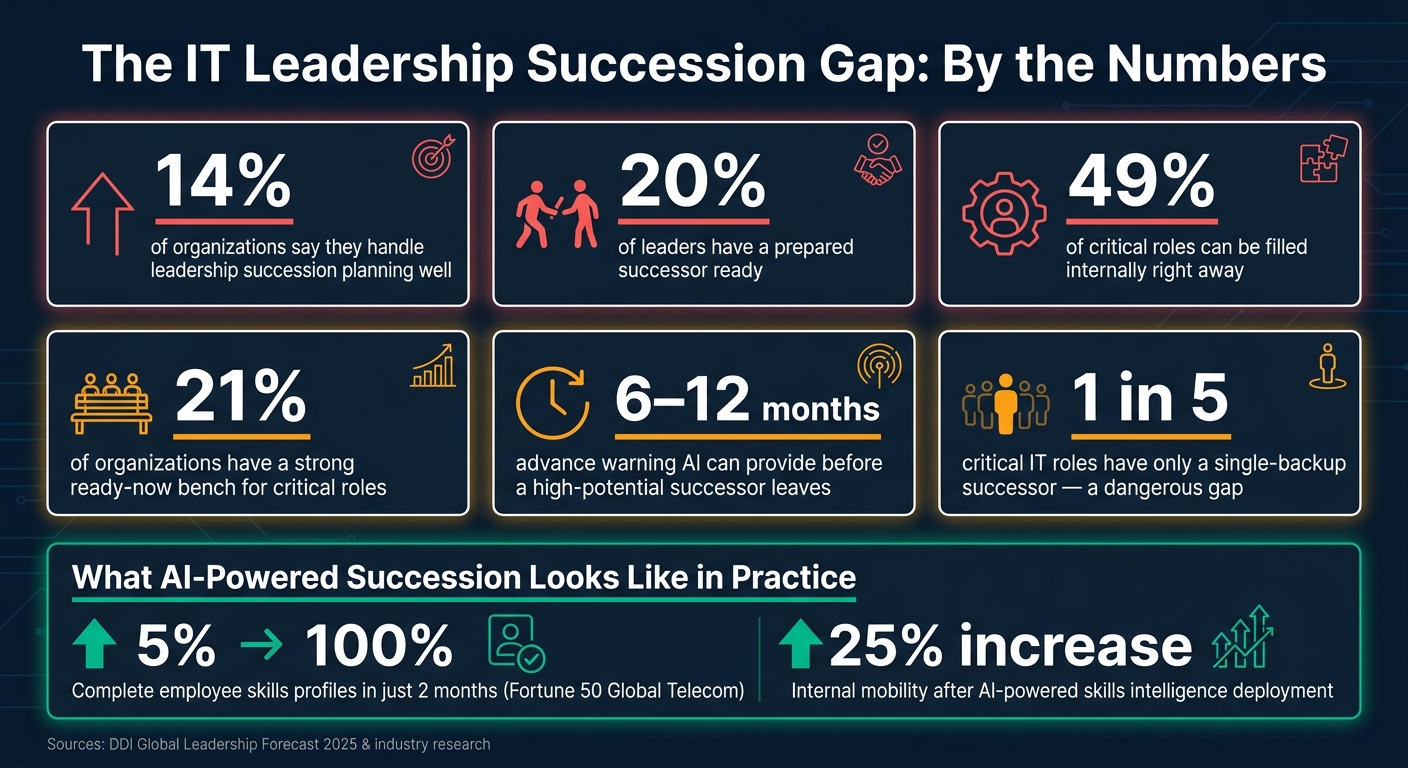
- One global telecom went from 5% complete skills profiles to 100% in two months
- The same company saw a 25% jump in internal mobility
- Only 20% of leaders have a prepared successor
- Just 49% of critical roles can be filled internally right away
- Only 14% of organizations say they handle leadership succession planning well
- Only 21% say they have a strong ready-now bench for critical roles
If I boil the whole piece down, it’s this: AI makes succession planning less reactive, more consistent, and easier to update – but people still need to review the output and make the final choice.
AI in IT Leadership Succession Planning: Key Statistics
Nala : How AI is Transforming Succession Planning & Critical Roles | Skills-Based Organizations
sbb-itb-05efa2a
How AI Improves Talent Identification for Future IT Leaders
Most succession charts are static snapshots. They make leaders look easier to spot than they are, and they often hide who’s not yet ready. AI changes that. It turns workforce data into a current view of leadership potential across the whole organization.
Using Workforce Data to Find High-Potential IT Managers
To spot future CIOs, CTOs, and CISOs, AI pulls signals from performance, mobility, and skills data across the workforce. Put together, those signals show growth patterns that managers often miss.
For example, a security analyst who leads incident reviews and mentors peers may show leadership potential long before getting a manager title. The same goes for an engineer who pushes cross-team cloud migrations forward and earns advanced certifications. Those behaviors matter at the executive level: cross-functional influence, ownership during incidents, and calm decision-making under pressure. Data can surface them before they show up on an org chart.
NLP can also give more weight to comments about cross-functional leadership and end-to-end ownership than to comments focused only on individual technical output. That difference helps separate a strong contributor from a future IT executive. Once potential leaders are spotted, the next step is to track whether they’re moving toward real readiness.
The payoff is measurable. A Fortune 50 global telecom used AI-powered skills intelligence and went from 5% complete employee skills profiles to 100% in just two months. It then reported a 25% increase in internal mobility. That kind of shift helps organizations see leadership potential much earlier.
Manual Talent Reviews vs. AI-Powered Talent Intelligence
The gap between old-school succession reviews and AI-supported talent identification isn’t only about speed. It’s about what gets seen and what slips through the cracks.
Identification is only the first step; readiness still has to be measured over time.
| Dimension | Manual Talent Reviews | AI-Powered Talent Intelligence |
|---|---|---|
| Objectivity | Relies on manager perception and recent impressions | Applies consistent scoring rules across all employees using standardized data |
| Speed | Updated annually through calibration meetings | Refreshed continuously as new performance and project data flows in |
| Visibility into hidden talent | Limited to known high-performers and current managers | Surfaces strong contributors in remote teams, specialized roles, and underrepresented groups |
| Bias reduction | Prone to affinity bias, halo effects, and political influence | Focuses on evidence-based signals; requires ongoing auditing to avoid replicating historical inequities |
| Future skill alignment | Tends to reward legacy strengths and current role performance | Can be configured to prioritize cloud, cybersecurity, AI literacy, and digital transformation experience |
AI sharpens judgment; it doesn’t replace it. It cuts down blind spots and gives leaders a shortlist based on readiness, not familiarity.
How AI Strengthens Performance Tracking and Knowledge Transfer
After AI spots high-potential managers, the next step is simple to say and harder to prove: are they getting closer to senior-level readiness over time? That’s the part that matters. And right alongside it sits another issue many teams learn too late – making sure key knowledge doesn’t walk out the door when a senior leader leaves.
Tracking Leadership Readiness with Operational and Business Metrics
Annual reviews show a moment in time. They don’t show momentum.
To track readiness well, organizations need operational and business metrics, not just technical ones. System uptime, incident response time, and mean time to resolution show whether a manager can keep operations steady. Project delivery rates, budget adherence, and change management performance show whether they can deliver under business pressure. Stakeholder satisfaction scores and security outcomes show whether they can build trust across the organization while handling risk.
In plain terms, stable service levels, on-budget delivery, and strong change management tell you more than a single review score ever could. AI ties those signals together over time and compares them with peer and historical outcomes. That helps flag actual leadership readiness, not just strong technical output.
Those readiness profiles also need an expiration date. If the latest proof is too old, the profile shouldn’t be treated as current. Flag any successor profile whose latest evidence is older than 9–12 months.
Preserving Critical IT Knowledge Before Leadership Gaps Appear
Readiness tracking works best when it’s paired with knowledge capture before a leadership gap opens up.
When a CIO, infrastructure director, or CISO leaves, they often take a lot with them: system history, fragile vendor ties, real compliance risks, and the backstory behind past outages. That information usually isn’t sitting neatly in one place. More often, it’s spread across email threads, ticketing systems, meeting notes, and undocumented institutional know-how.
AI can pull that scattered material into a searchable knowledge base. By ingesting architecture documents, incident postmortems, compliance logs, cloud strategy notes, and vendor history, AI gives successors structured access to the context they need. A new IT leader can search that knowledge base and get up to speed fast.
A practical place to start is with the roles where knowledge loss would hit hardest – usually positions tied to rare expertise and high operational impact. From there, organizations can begin structured capture programs before any transition starts. The point is to document decisions as they happen, not scramble to piece them together after someone gives notice.
Manual Tracking vs. AI-Enabled Readiness Monitoring
The gap between manual tracking and AI-enabled monitoring isn’t only about speed. It’s about how much gets captured, how well it holds up, and whether it survives leadership turnover.
| Dimension | Manual Tracking | AI-Enabled Monitoring |
|---|---|---|
| Timeliness | Annual or ad hoc; often stale | Continuously updated as new data flows in |
| Data Depth | Subjective observations; limited to what managers report | Combines operational, delivery, security, and business data |
| Continuity | Breaks when managers change | Persistent tracking that survives personnel changes |
| Compliance Traceability | Manual audits; documentation often incomplete | Automated traceability across compliance records and incident logs |
| Onboarding Value | Relies on personal handoffs; slow ramp-up for successors | Searchable knowledge base with context and history |
Manual methods have another problem: they often vanish when the person who set them up leaves. AI-enabled systems keep readiness data and organizational knowledge linked across leadership changes, so teams don’t have to rebuild the whole picture every time a senior role turns over.
How AI Improves Succession Decisions and Reduces Leadership Risk
Once readiness and knowledge are tracked, the next step is simple: who moves when a critical IT role opens up? Tracking readiness only matters if it leads to the right succession choice at the right moment.
Using Predictive Analytics to Spot Bench Gaps and Flight Risk
The biggest succession risk in IT usually isn’t making a bad hire. It’s finding out too late that no one is ready to step in. According to the DDI Global Leadership Forecast 2025, only 20% of leaders have a prepared successor, and just 49% of critical roles could be filled internally right away.
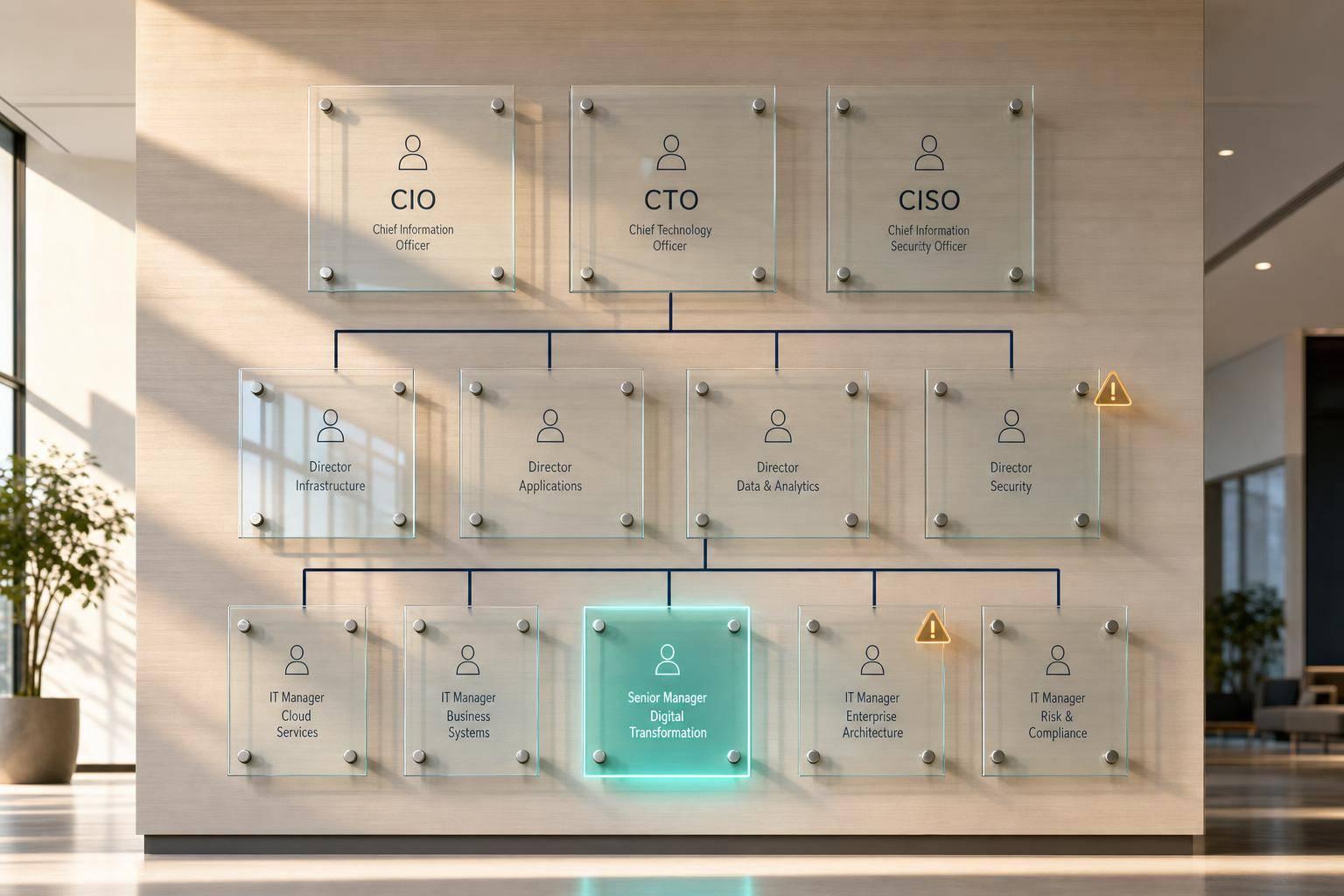
This is where predictive analytics helps. It can model bench depth by role and show where coverage is thin. For each critical position – CISO, Director of Cloud Engineering, VP of Enterprise Applications, or Head of Infrastructure – AI can estimate how many internal candidates meet set readiness thresholds, score how well their skills match the role, and flag positions with only one ready-now successor. That’s a single-backup risk.
AI can also spot flight risk earlier than most managers can. By looking at engagement survey trends, pay competitiveness against U.S. market benchmarks, promotion pace compared with peers, and behavior signals like lower collaboration, predictive models can estimate the odds that a high-potential successor will leave in the next 6–12 months. That gives leaders time to start a development and retention conversation before it’s too late.
Those signals should guide executive review, not replace it.
Governance Rules for Responsible AI Use in IT Leadership Planning
Once those risk signals are visible, the process needs guardrails. AI recommendations are only as good as the controls behind them.
Require explainable rankings for every candidate, whether the role is CISO or cloud director. Use audited input data. Build in at least two review cycles before formal scoring. Final executive appointments should still go through a human committee, usually the CHRO, CIO, and a business leader, that reviews the model output and documents the decision.
That record matters. It makes the process easier to defend during an internal audit or board review, and each recommendation should be logged as either accepted or rejected.
Building an AI-Enabled IT Succession Plan with the Right Support
Once you’re tracking readiness, the next job is to turn that information into a plan people can use.
Start by defining what each role needs to deliver. That means setting clear outcomes such as uptime targets, incident-response SLAs, cloud spend against budget, and compliance duties. Those markers become the standard AI uses for scoring.
Then bring the data together in one place. If the data is patchy, the AI scores will be weak too. With that base in place, AI can map the internal pipeline, point out bench gaps, and show where development should be focused during quarterly succession reviews.
If there’s still no clear successor in the internal pipeline, it’s time to look outside.
Where Equifier Fits in IT Leadership Succession Planning
When AI shows that no internal candidate is close to ready for a critical role, that’s a clear sign to get outside help. Equifier can step in by sourcing senior IT professionals for full-time or contract roles, advising on the cybersecurity risk and compliance demands a future CISO or CIO will carry, and sharpening skill profiles tied to infrastructure, cloud, and security priorities.
| AI Succession Planning Need | Equifier Service |
|---|---|
| No "ready now" successor for a critical IT role | Recruiting & Staffing Solutions (full-time and contract) |
| Unclear compliance or security expectations for leadership roles | Cybersecurity Consulting (risk assessments and compliance) |
| Stale skill profiles for infrastructure, cloud, or security | IT Consulting & Services |
| External search for senior-level IT or security executives | Executive Search |
Conclusion: What AI Changes in Succession Planning
With the operating model and outside support set, the last issue is what AI changes day to day.
AI makes succession planning more accurate and less reactive. Only 14% of organizations say they manage leadership succession planning well, and just 21% say they have a strong bench of ready-now successors for critical roles. Teams that close that gap use AI-driven insight, pair it with clear human judgment, and bring in outside support when the internal pipeline runs thin. That shifts succession planning from a compliance checkbox into a real edge.
FAQs
How does AI identify future IT leaders?
AI spots future IT leaders by looking at technical skills, work history, and performance data, then comparing those signals with what leadership roles call for. With predictive analytics and data-based insight, teams can judge leadership potential in a more even-handed way and rely less on gut feel alone.
It also follows career growth and skill gains over time. That makes it easier for organizations to match high-potential employees with roles in project management and strategic planning.
What data is needed for AI succession planning?
AI succession planning works best when it runs on complete, up-to-date data for every key role and person. That means looking at:
- skills and competencies
- performance and project outcomes
- documented knowledge assets
- access to and ownership of critical systems
It also needs risk signals, such as bus factor, along with knowledge gaps and capacity constraints. Without that, succession planning turns into guesswork. With it, teams can make data-based calls on training, cross-training, and replacement priorities.
How do companies use AI without adding bias?
Companies cut bias by steering AI toward objective signals like technical skills and job history, while leaving out personal details in the first screening round. They also tune scoring rules to fit each role and make AI recommendations easy to follow.
That part matters. If a hiring team can’t explain why a tool ranked one person above another, it’s hard to trust the result.
To keep bias in check over time, teams:
- review AI decisions on a regular basis
- train models on balanced data
- adjust hiring steps as they learn what works
- pair AI with structured interviews and human review
Used this way, AI supports the process instead of running it alone.