










AI improves candidate matching by reading resumes and job posts by meaning, not just exact words. In IT recruiting, that means fewer missed candidates, better shortlists, and less manual screening. One data point stands out: teams using AI-assisted matching reviewed 62% fewer profiles to find a qualified candidate.
Here’s the short version of how I’d explain it:
- NLP structures messy resume data into skills, titles, certifications, and experience
- Normalization reduces language gaps like “software engineer” vs. “developer”
- Semantic search finds fit by context instead of exact keyword matches
- ML ranking sorts candidates using past hiring results and profile signals
- Human review checks weak or risky matches before decisions move forward
- Tracking results over time helps spot drift, gaps, and uneven outcomes
What matters most is simple: clean data in, better matches out. If I rely on keyword filters alone, I can miss people with the right background but different wording. If I add structured data, semantic scoring, and recruiter review, matching gets tighter and easier to check.
A quick comparison makes that clear:
| Method | What it looks at | Main limit |
|---|---|---|
| Keyword matching | Exact words | Misses synonyms and context |
| TF-IDF | Term weight and frequency | Better than keywords, but still text-led |
| Semantic matching | Meaning and role fit | Needs clean inputs and review |
| ML ranking | Predicted fit from past results | Depends on training data quality |
If I want better candidate matching in IT staffing, the formula is straightforward: structure the data, score by meaning, rank with hiring signals, and keep a person in the loop.
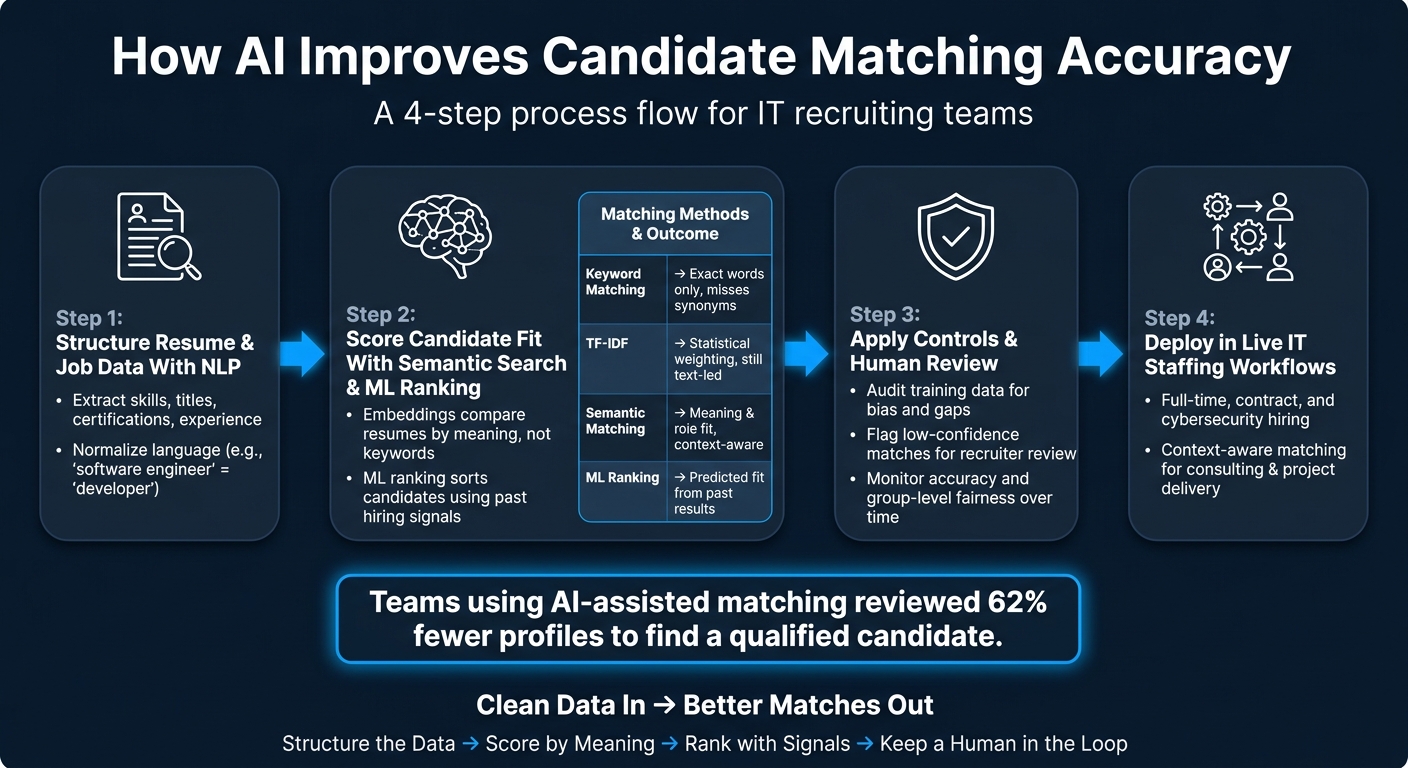
How AI Improves Candidate Matching: 4-Step Process
Step 1: Structure Resume and Job Data With NLP
Once resumes and job descriptions are structured, NLP turns messy, unstructured text into fields AI can actually match. Resumes and job posts come in all kinds of formats, so this step converts raw text into organized data the matching system can compare. That base helps AI assess candidates with better precision in the next step.
Extract Skills, Titles, Certifications, and Experience Signals
NLP systems pull out the details recruiters look for in resumes and job descriptions, such as skills, job titles, certifications, and years of experience. Context-aware parsing looks at the full career path, not just a title in isolation. That matters in U.S. IT hiring, where technical skills in software engineering, cloud, and cybersecurity need to be identified with care.
Normalize Inconsistent Resume Language
After extraction, the data is still messy. One candidate may write "software engineer", while another says "developer." AI normalizes synonyms, abbreviations, tools, and frameworks into standard terms, which cuts down on false mismatches between equivalent skills. After that, semantic search can compare candidates based on meaning, not just wording.
sbb-itb-05efa2a
Step 2: Use Semantic Search and ML Ranking to Score Candidate Fit
Semantic search and machine learning ranking score candidate fit by meaning, not exact wording. Semantic search handles relevance. Ranking models decide who should move to the top of the list.
Use Embeddings to Compare Resumes and Job Descriptions by Meaning
Embeddings help AI compare resumes and job descriptions based on meaning, not just matching words. So two people can line up well for the same role even if they describe similar experience in very different ways.
That matters a lot in hiring. One candidate might say “account management,” while another says “client portfolio ownership.” The wording is different, but the work may be close. Embeddings help the system see that connection.
They can also account for filters like salary, location, and clearance needs.
That relevance signal gets better when the model learns from past hiring outcomes.
Add Supervised Machine Learning for Ranking and Prioritization
Semantic similarity gives you a good relevance signal. But if you want to rank candidates by predicted fit, you’ll usually need supervised machine learning.
These models learn from past placement success and other hiring signals to sort candidates by priority. They tend to work best when they’re trained on structured profile data and past hiring outcomes. In plain English: the cleaner the data, the better the ranking.
This can cut down on manual review and speed up shortlist creation.
Keyword, TF-IDF, and Semantic Matching: A Method Comparison
Here’s the simple version:
- Keyword search finds exact terms only, so it often misses synonyms and context.
- TF-IDF matching adds statistical weighting to bring more relevant terms to the surface.
- Semantic matching focuses on intent and role fit, reading meaning across different resume language and job descriptions.
Even then, model output should be reviewed before it drives hiring decisions. The next step is putting controls in place so the model stays accurate and fair.
Step 3: Improve Accuracy With Controls and Human Review
Once the model starts ranking candidates, you need controls to keep those rankings trustworthy. Better matching accuracy comes from three things working together: the algorithm, clean data, and human review.
Audit Training Data and Matching Outcomes
Start by auditing training data for label consistency, field completeness, and representation gaps. Biased or incomplete history can skew future rankings.
These checks also show where recruiter review matters most. If the data is thin, uneven, or messy in one part of the pipeline, that’s usually where human judgment needs to step in.
Use Human-in-the-Loop Review for Low-Confidence and Sensitive Decisions
AI should rank candidates first, then flag low-confidence matches for recruiter review. Recruiters should also be able to override borderline or high-risk decisions, especially in cybersecurity hiring. Feed those validated overrides back into the model.
It helps to track reviewed decisions over time too. That makes it easier to spot drift before it turns into a bigger problem.
Monitor Match Accuracy and Group Performance Over Time
Accuracy doesn’t stay fixed. A model that worked well six months ago can drift as job needs change or new candidate pools enter the mix. Ongoing monitoring helps keep the system calibrated.
| Monitoring Level | Focus Areas | Key Metrics |
|---|---|---|
| Operational accuracy | Efficiency and volume | Time-to-fill, profiles reviewed per hire, recruiter acceptance rate |
| Accuracy and fairness | Quality, efficiency, and compliance | Interview conversion, placement retention, group-level performance gaps, candidate response rate |
For U.S. staffing teams, tracking group-level performance gaps can show whether the model is treating some candidate groups differently over time. That can point to fairness or compliance issues.
Step 4: Apply AI Matching in IT Staffing Workflows With Equifier

With structured data, semantic scores, and human review in place, Equifier brings matching into live recruiting workflows. That means the model’s output doesn’t just sit in a dashboard. It helps teams make day-to-day sourcing decisions.
Use AI Matching for Full-Time, Contract, and Cybersecurity Hiring
For full-time hiring, AI matches candidates to long-term company needs and helps improve fit over time.
For contract staffing, AI works through large applicant pools and spots niche technical skills faster than manual review.
Cybersecurity hiring uses the same matching approach, but puts more weight on compliance and risk context. For cybersecurity roles, AI maps candidate capabilities to risk assessments, compliance work, and managed security services. Semantic search can pick up signals like zero-trust experience or compliance exposure that basic keyword filters often miss.
Align Talent Matching With Consulting and Project Delivery Needs
For client work, AI needs to match candidates to the project itself, not just the title on the req. A cloud background, for example, can be weighted toward infrastructure optimization work. Compliance experience can be tied to cybersecurity risk assessments. That kind of context-aware matching goes further than simple keyword filtering.
AI scores candidate fit, then recruiters check those results through assessments and review. When a role calls for a security-first mindset or compliance exposure, that human check helps keep hiring decisions accurate and in line with the brief.
Conclusion: Build a Repeatable AI Matching Process
AI matching works best when resume data and job data are structured, ranking is automated, and recruiters step in for edge cases. But that setup only holds up if IT recruiting teams keep the data clean and keep checking the model.
The numbers back that up: teams using AI-assisted matching have reviewed 62% fewer profiles to find a qualified candidate.
When structure, semantic ranking, and human review work together – and teams monitor the system on a steady basis – matching gets more consistent and easier to audit. In that setup, AI helps teams match candidates faster, with better precision, and in a way they can repeat.
FAQs
How does AI reduce missed candidates?
AI cuts down on missed candidates by doing more than basic keyword matching. It looks at the context behind a candidate’s experience, not just whether a resume includes an exact term. So if someone doesn’t use the same wording as the job post, AI can still spot related skills and relevant background.
It can also search across multiple databases, social networks, and professional profiles to surface more qualified candidates, including passive candidates who may not be actively applying.
And by automating resume screening and other repetitive tasks, AI helps keep strong applicants from slipping through the cracks.
What data quality issues hurt match accuracy?
Missing, incorrect, outdated, incomplete, or duplicate candidate data can hurt match accuracy. And when resumes use inconsistent terms, keyword-based screening gets a lot less dependable.
There’s another problem, too. If ATS, assessment, and interview data aren’t connected or recorded cleanly, candidates can slip through the cracks. In some cases, teams end up judging people on the wrong traits, which leads to weaker matches.
Why is human review still needed?
Human review still matters in hiring. It helps teams check for bias, keep decision-making accountable, and make sure candidates are judged fairly.
AI can speed up sourcing and matching, which is helpful when you’re sorting through a large pool of applicants. But hiring isn’t just a keyword game. A strong candidate may bring judgment, grit, communication skills, or team fit that software doesn’t fully pick up.
That’s where human oversight comes in. People can spot the nuances AI may miss, look more closely at behavior and soft skills, and make room for context that doesn’t fit neatly into a data point. Used this way, AI supports the process, while humans help keep it fair and grounded.